


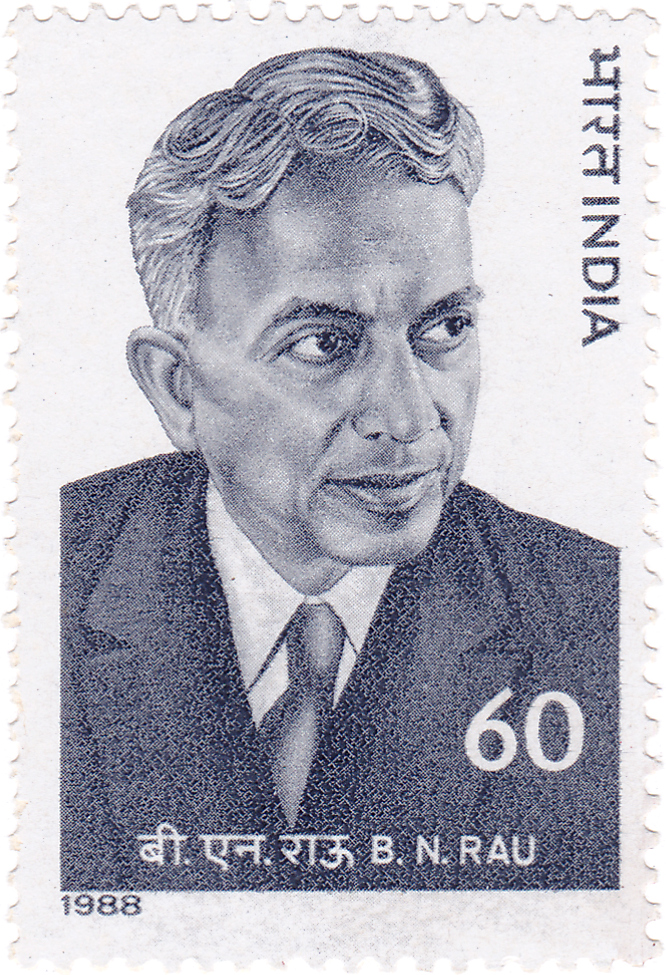

Sir Benegal Narsing Rau (26 February 1887 – 30 November 1953) was an Indian civil servant, jurist and diplomat. As Constitutional Adviser to the Constituent Assembly he prepared the first draft of the Constitution of India, on which the drafting committee under B. R. Ambedkar then worked. He later represented India at the United Nations, where he presided over the Security Council at the outbreak of the Korean War, and was the first Indian judge of the International Court of Justice.
Quick Facts
| Full name | Benegal Narsing Rau |
| Born | 26 February 1887, Mangalore, Karnataka |
| Died | 30 November 1953, Zurich, Switzerland (aged 66) |
| Education | Presidency College, Madras; Trinity College, Cambridge |
| Service | Indian Civil Service (1910) |
| Offices | Judge, Calcutta High Court; Prime Minister of Jammu and Kashmir (1944–1945); Constitutional Adviser to the Constituent Assembly (1946–1949); Permanent Representative to the United Nations (1949–1952); Judge, International Court of Justice (1952–1953) |
| Honours | Knighted 1938 |
Early Life
He was born at Mangalore into a Chitrapur Saraswat Brahmin family; his father was a doctor. He stood first in the whole Madras Presidency in his school examination, took a triple first at Presidency College in English, physics and Sanskrit, and went to Trinity College, Cambridge, on a scholarship.
He passed into the Indian Civil Service and was posted to Bengal. His brothers were also distinguished: Benegal Rama Rau became Governor of the Reserve Bank, and B. Shiva Rao a journalist and member of Parliament.
Jurist in the Civil Service
He chose the judicial branch, served as a district judge in Bengal and Assam, and became the foremost legal draftsman in the government.
- **Revising the statute book:** after the Government of India Act of 1935, he was given the task of revising the whole body of central and provincial laws to fit it, and finished in eighteen months. He was knighted.
- **The Calcutta High Court:** he was a judge there from 1939
- **The Indus:** he headed a commission on the dispute between Sind and Punjab over the river’s waters, whose principles were later drawn on in the Indus treaty
- **Hindu law:** he chaired the committee that proposed a uniform code of Hindu law on marriage and inheritance, giving daughters and widows rights of succession. It was the origin of the Hindu Code enacted in the 1950s; see B. R. Ambedkar.
He retired in 1944 and served for a year and a half as Prime Minister of the state of Jammu and Kashmir, resigning after differences with the Maharaja.
Constitutional Adviser
In July 1946 he was appointed Constitutional Adviser to the Constituent Assembly. He took no salary.
Before the Assembly met he prepared notes and summaries of the constitutions of the world for its members. He drew up the questionnaires and memoranda on which its committees worked. In October 1947 he produced a complete draft Constitution, of 243 articles and 13 schedules, embodying the decisions the Assembly had taken up to then. The drafting committee, with Ambedkar in the chair, began from this text and revised it over the following months.
In late 1947 he travelled to the United States, Canada, Ireland and Britain to consult judges and statesmen. A conversation with Justice Felix Frankfurter of the American Supreme Court, who warned him of the uncertainty that the phrase “due process of law” had caused in his country, led to the wording “procedure established by law” in the article on personal liberty. The directive principles of state policy, a feature he borrowed from the Irish constitution, were also his suggestion.
Ambedkar, in his closing speech to the Assembly in November 1949, said that part of the credit given to him belonged to B. N. Rau, who had prepared the rough draft. The President of the Assembly, Rajendra Prasad, paid a similar tribute.
In the same years he helped the leaders of Burma to draft their constitution.
The United Nations
He was India’s Permanent Representative at the United Nations from 1949 to 1952. India then held a seat on the Security Council, and he was its president in June 1950 when North Korea invaded the South and the Council voted to resist. Through the war he worked for a ceasefire and for the proposals on prisoners that eventually ended it. He was spoken of as a candidate for Secretary-General.
The World Court
He was elected a judge of the International Court of Justice at The Hague and took his seat in 1952. He fell ill within a year and died in Zurich on 30 November 1953.
Legacy
He disliked publicity and is far less known than his work deserves. India issued a stamp in his honour in 1988. Among those who interpreted the Constitution in the next generation were Nani Palkhivala and Fali Nariman.
Featured image: B. N. Rau, from a 1988 postage stamp of India. Photo by India Post, Government of India, licensed under Government Open Data License – India, via Wikimedia Commons.