


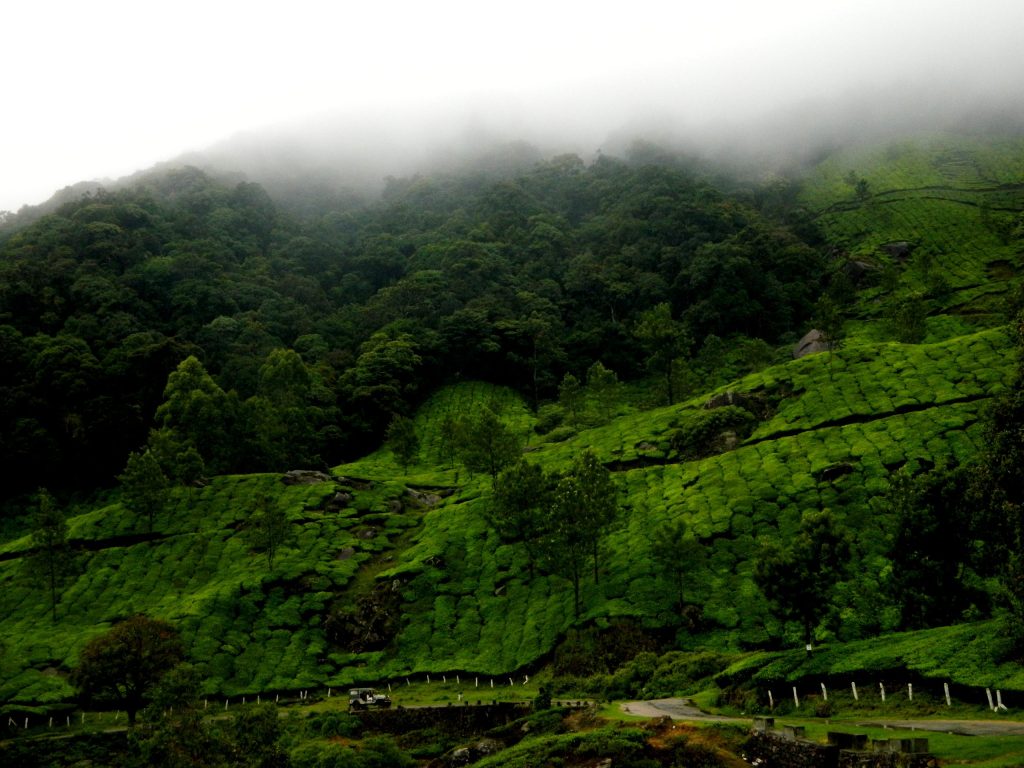

The Western Ghats are a chain of mountains running parallel to the west coast of India for about 1,600 kilometres, from Gujarat to the southern tip of the peninsula. They are older than the Himalayas and are among the richest places on Earth for plant and animal life. UNESCO inscribed them as a World Heritage Site in 2012.
At a glance
- Location: Kerala, Karnataka, Tamil Nadu and Maharashtra (the listed areas)
- Inscribed: 2012
- Type: Natural
- Listed components: 39 national parks, sanctuaries and reserved forests
- Highest peak: Anamudi, Kerala, 2,695 metres
The mountains
The Ghats, also called the Sahyadri in the north, form the western edge of the Deccan plateau. They rise steeply from the narrow coastal plain and slope gently to the east. Only one major gap, at Palakkad in Kerala, breaks the chain.
Maker of the monsoon
The mountains stand in the path of the south-west monsoon winds. Forced upward, the moist air drops its rain on the western slopes, which receive some of the heaviest rainfall in India, while the plateau behind lies in a rain shadow. The great rivers of the peninsula, the Godavari, the Krishna and the Kaveri, rise in the Ghats and flow east. Hundreds of millions of people depend on their water.
The forests
The range carries tropical evergreen rainforest, moist and dry deciduous forest, and, on the highest ground of the south, a unique landscape of rolling grassland with pockets of stunted evergreen forest called sholas.
Wildlife found nowhere else
- Lion-tailed macaque: a black monkey with a silver mane, living in the rainforest canopy
- Nilgiri tahr: a mountain goat of the high grasslands
- Nilgiri langur and Malabar giant squirrel
- Frogs: well over a hundred endemic species, including the strange purple frog, discovered in 2003
- Plants: thousands of flowering species, including the neelakurinji, a shrub that flowers once in twelve years and turns the hills blue
The Ghats also hold the largest population of Asian elephants in the world and a large share of India’s tigers.
Some of the listed areas
Silent Valley, Periyar and Eravikulam in Kerala; Kalakkad-Mundanthurai and the Nilgiri forests in Tamil Nadu; Kudremukh and Pushpagiri in Karnataka; and the Kaas plateau and Koyna in Maharashtra.
Threats
Mining, dams, plantations, roads and the spread of towns have fragmented the forests. Two expert committees have recommended that large parts of the range be declared ecologically sensitive, a proposal still argued over by the states.
Why it is a World Heritage Site
UNESCO recognises the Western Ghats as one of the world’s eight “hottest hotspots” of biological diversity, and for the ecological processes by which the mountains shape the monsoon climate.
Visiting
The hill stations of Munnar, Ooty, Kodaikanal, Coorg and Mahabaleshwar, and parks such as Periyar and Eravikulam, are the usual ways in. The months after the monsoon, from October to March, are the most comfortable.
Image: The hills of the Western Ghats near Munnar, Kerala. Photo by GowthamNR, licensed under CC BY-SA 4.0, via Wikimedia Commons.