


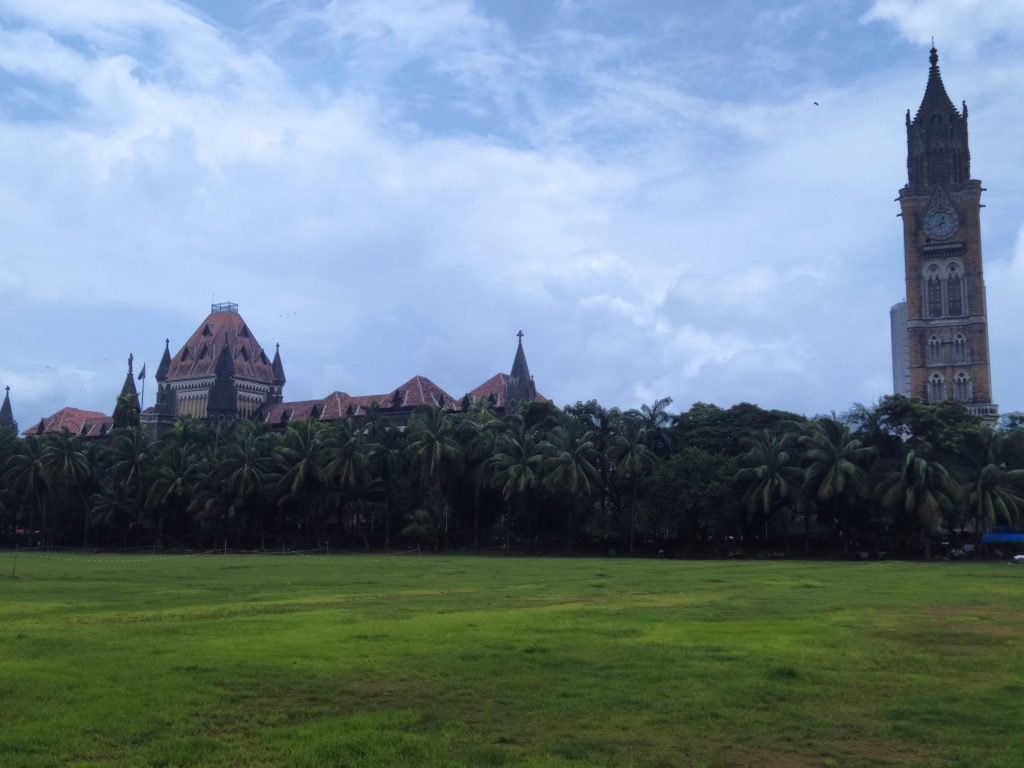

In south Mumbai a long green cricket ground, the Oval Maidan, separates two rows of buildings from two different ages. On the east side stand the grand Gothic public buildings of the nineteenth century; on the west, the sleek Art Deco apartment blocks of the 1930s. Together they were inscribed by UNESCO as a World Heritage Site in 2018.
At a glance
- Location: Fort and Marine Drive, Mumbai, Maharashtra
- Inscribed: 2018
- Type: Cultural
- Period: 1860s to 1940s
- Buildings: about 94
The Victorian side
In the 1860s the walls of the old Bombay fort were pulled down. The city was growing rich on the cotton trade, and the government used the cleared ground for a line of public buildings in the Gothic Revival style, adapted to the climate with deep verandahs and balconies.
- Bombay High Court: completed in 1878
- University of Mumbai: the Convocation Hall and library, designed by Sir George Gilbert Scott, with the Rajabai Clock Tower, 85 metres high, paid for by the banker Premchand Roychand and named after his mother
- Old Secretariat, the Public Works Department building and the City Civil Court
- Elphinstone College and the David Sassoon Library
The Art Deco side
In the 1920s and 1930s land was reclaimed from the sea at Back Bay. On it rose blocks of flats, cinemas and hotels in the fashionable international style of the day, built in reinforced concrete.
- Features: curved corners, streamlined balconies, porthole windows, stepped towers, and reliefs of tropical plants, waves and sunbursts. The local version, mixing in Indian motifs, has been called Indo-Deco.
- Landmarks: the Eros and Regal cinemas, and the row of buildings along Marine Drive, the seafront boulevard known as the Queen’s Necklace for its lights at night
Mumbai is often said to have the largest collection of Art Deco buildings in the world after Miami.
Why it is a World Heritage Site
The two ensembles record two phases in the modernisation of the city, and show how European styles were reinterpreted in India. Almost all the buildings are still used for their original purposes.
Visiting
The area can be covered in a morning’s walk beginning at the Oval Maidan. Nearby is another World Heritage Site, Chhatrapati Shivaji Maharaj Terminus.
Image: The Bombay High Court and the Rajabai Clock Tower seen from the Oval Maidan, Mumbai. Photo by Radosław Botev, licensed under CC BY 3.0 pl, via Wikimedia Commons.