


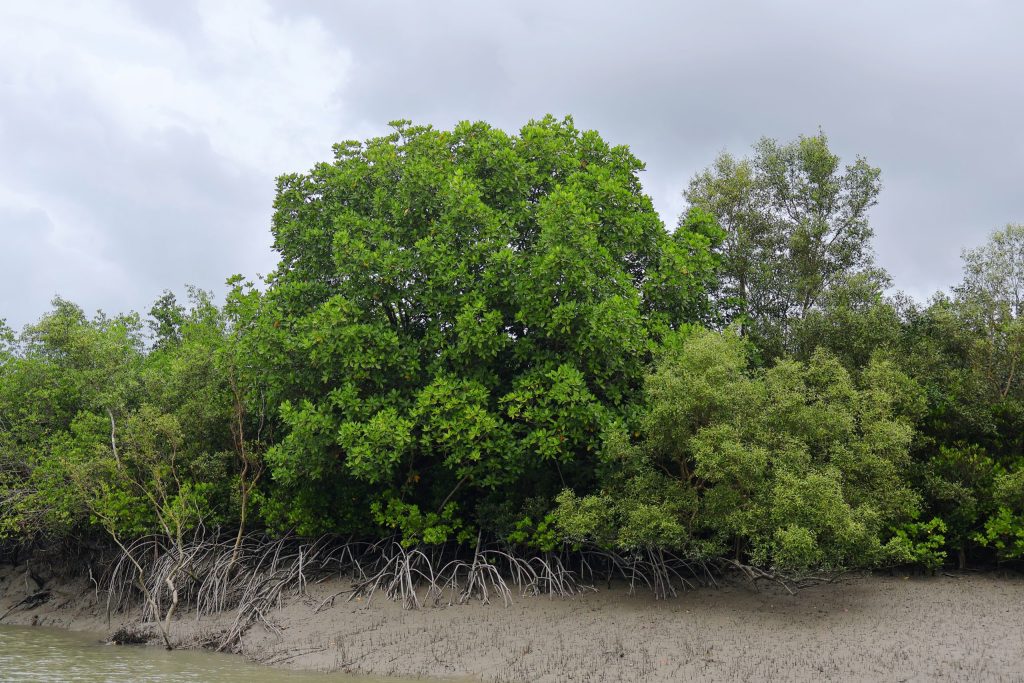

Where the Ganga, the Brahmaputra and the Meghna reach the Bay of Bengal, they form the largest delta in the world, and on its seaward edge grows the largest mangrove forest. The Indian part of it, Sundarbans National Park, was inscribed by UNESCO as a World Heritage Site in 1987.
At a glance
- Location: South 24 Parganas district, West Bengal
- Inscribed: 1987
- Type: Natural
- Core area: about 1,330 square kilometres
- Also: tiger reserve (1973) and biosphere reserve
The forest continues across the border into Bangladesh, where it is a separate World Heritage Site.
The landscape
The Sundarbans is a maze of islands, mudflats and channels, covered and uncovered twice a day by the tide. Mangrove trees survive in the salt water by breathing through roots that stick up out of the mud like spikes. The name is usually explained as coming from the sundari tree, once the commonest of them.
The tiger
The Sundarbans is the only mangrove forest in the world inhabited by tigers. About a hundred live in the Indian part.
- They swim readily between islands and eat fish and crabs as well as deer and wild boar.
- They have a reputation as man-eaters. People who enter the forest to fish, cut wood or collect honey are attacked every year.
- Honey collectors and fishermen of both faiths pray before going in to Bonbibi, the lady of the forest, who is believed to protect them from the tiger.
Other wildlife
- Estuarine crocodile: the largest living reptile
- Dolphins: the Gangetic and Irrawaddy dolphins
- Others: spotted deer, fishing cats, water monitors, king cobras, olive ridley turtles, and kingfishers, herons and eagles in great variety
People
More than four million people live on the settled islands around the forest, protected from the tide by earthen embankments. The mangroves shield them, and the city of Kolkata beyond, from the full force of cyclones.
Threats
- Rising sea level: some islands have already disappeared, and salt water is spoiling farmland
- Cyclones: Aila in 2009 and Amphan in 2020 broke the embankments and flooded villages
- Reduced fresh water from upstream, which makes the water saltier and harms the trees
Why it is a World Heritage Site
The Sundarbans is an outstanding example of a delta still being formed by natural processes and of a mangrove ecosystem with its full range of wildlife.
Visiting
There are no roads. Visitors travel by boat from Godkhali or Canning, about three hours from Kolkata, and watch from the deck and from fenced watchtowers. Tigers are seldom seen. The season is from October to March.
Image: Mangrove forest in the Sundarbans, West Bengal. Photo by Kingshuk Mondal, licensed under CC BY 4.0, via Wikimedia Commons.