


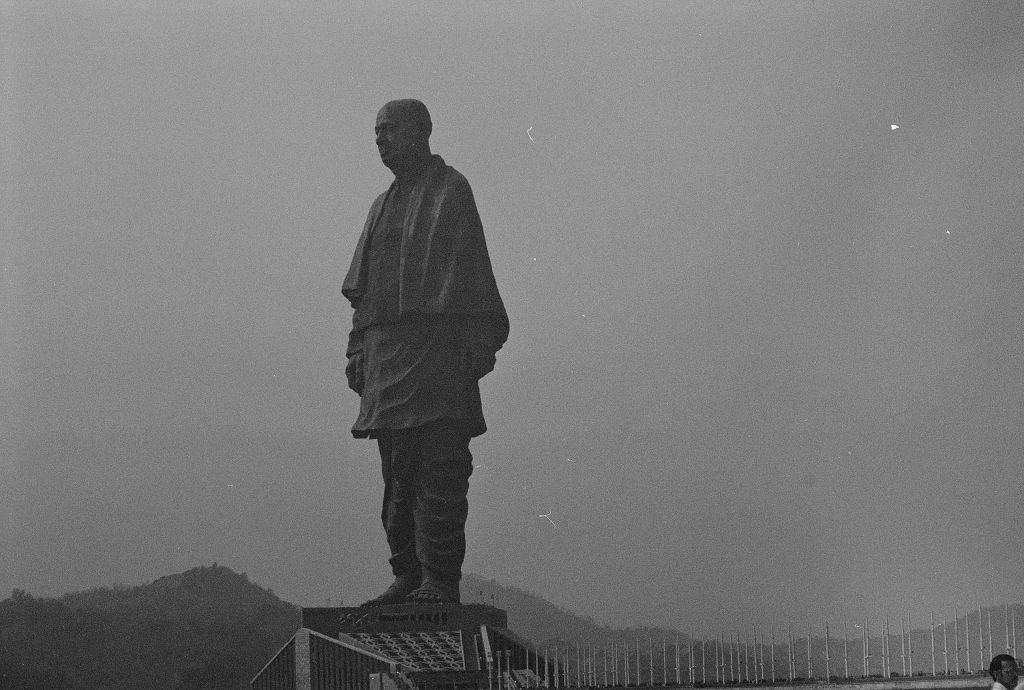

The Statue of Unity, near Kevadia in the Narmada valley of Gujarat, is the world’s tallest statue at 182 metres. It depicts Sardar Vallabhbhai Patel, who was India’s first deputy prime minister and home minister and played a major role in the political integration of the country. It faces the Sardar Sarovar Dam, about 100 kilometres south-east of Vadodara.
The project was announced on 7 October 2013 by Narendra Modi, then Chief Minister of Gujarat, to mark the start of his tenth year in the post, although Wikipedia notes another account saying it was first announced in 2010. A society, the Sardar Vallabhbhai Patel Rashtriya Ekta Trust, was formed to carry it out. A movement asked farmers to donate their used farm tools to collect the iron for the statue, and by 2016 some 135 metric tonnes of scrap iron had been collected, of which about 109 tonnes were processed and used in the foundation.
The design was chosen after a team of historians, artists and academics studied statues of Patel across the country, and the choice was the one submitted by the Indian sculptor Ram V. Sutar. It is a larger version of a statue of Patel at Ahmedabad airport. Three models measuring 0.91, 5.5 and 9.1 metres were made first, and once the largest was approved a 3D scan formed the basis for the bronze cladding, which was cast at a foundry in China.
The height of 182 metres was chosen deliberately, to match the number of seats in the Gujarat Legislative Assembly. The total structure is 240 metres, with a base of 58 metres and a statue of 182 metres.
The engineering challenge was stability. The statue shows Patel’s dhoti-clad legs and sandalled feet, which makes it narrow at the base, with a slenderness ratio between 16 and 19, much higher than most tall buildings, which range between 8 and 14. This was addressed in part by two tuned mass dampers of 250 tonnes each. The statue is designed to withstand winds of up to 180 kilometres an hour and earthquakes of magnitude 6.5 within 12 kilometres at a depth of 10 kilometres.
Larsen and Toubro won the contract on 27 October 2014 with the lowest bid of Rs 2,989 crore for the design, construction and maintenance, and began construction on 31 October 2014. It employed more than 3,000 workers and 250 engineers. The core used 210,000 cubic metres of cement and concrete, 6,500 tonnes of structural steel and 18,500 tonnes of reinforced steel, and the outer facade is made of 1,700 tonnes of bronze plates and 1,850 tonnes of bronze cladding in 565 large and 6,000 small panels. A consortium of Turner Construction, Michael Graves and Associates and the Meinhardt Group supervised the project, which took 57 months.
Funding came from a public-private partnership, with most of the money from the Gujarat government, which allotted Rs 500 crore in its budgets from 2012 to 2015, and Rs 200 crore in the 2014 to 2015 Union Budget, and contributions from public sector companies under corporate social responsibility. The government estimated the total cost at about Rs 2,063 crore, while the contract value was Rs 2,989 crore and the contract covered design, construction and maintenance, so the cost figure depends on what is counted.
Narendra Modi, by then Prime Minister, inaugurated the statue on 31 October 2018, the 143rd birth anniversary of Patel. It has five zones, of which three are open to the public. Two lifts in each leg carry 26 people at a time to a viewing gallery at 153 metres, which holds up to 200 people.
More than 128,000 people visited in the first eleven days after it opened on 1 November 2018, and it received 2.9 million visitors in its first year, with Rs 82 crore in ticket revenue. It was visited by 10 million people by November 2022. It stands as a work of public engineering, built from scrap iron, concrete and cast bronze to honour one man.
Featured image: The Statue of Unity in Gujarat (file photo). Photo by Veera.sj, licensed under CC0, via Wikimedia Commons.