



Protests in Delhi over the past week, including the detentions at Jantar Mantar and the march by opposition MPs, have centred on three letters: SIR. Here is what the term means.
What it is
The Special Intensive Revision is an exercise by the Election Commission of India to rebuild the electoral rolls, the lists of people entitled to vote. In an ordinary annual revision, names are added and removed from the existing list. In an intensive revision, booth-level officers go from house to house, every elector is asked to fill in a form, and the list is in effect prepared afresh.
The phases
- Phase I: Bihar, in mid-2025, ahead of the state’s assembly election.
- Phase II: Twelve states and Union Territories, announced in October 2025.
- Phase III: Sixteen states and three Union Territories, announced in May 2026 and covering about 36 crore electors.
Phase III covers Andhra Pradesh, Arunachal Pradesh, Haryana, Jharkhand, Karnataka, Maharashtra, Manipur, Meghalaya, Mizoram, Nagaland, Odisha, Punjab, Sikkim, Tripura, Telangana and Uttarakhand, along with Delhi, Chandigarh, and Dadra and Nagar Haveli and Daman and Diu. Final rolls are being published state by state between September and December 2026.
What the Commission says
The Commission says the rolls had not been intensively revised for about two decades and contained the names of people who had died, moved or were registered twice, and that the revision is needed to make them accurate. It has rejected allegations of wrongdoing.
What critics say
- Deletions: Opposition parties allege that large numbers of genuine voters, particularly the poor, migrants and minorities, have been struck off.
- Documents: Critics say the proof demanded is hard for many citizens to produce.
- Citizenship: They argue that the exercise amounts to a citizenship test, which is not the Commission’s job.
Opposition parties and student groups are demanding the resignation of the Chief Election Commissioner, Gyanesh Kumar.
In the courts
The revision has been challenged in the Supreme Court since the Bihar phase. Separately, the court is dealing with challenges to the 2023 law under which Election Commissioners are appointed.
What a voter should do
Anyone in a state under revision can check the draft or final roll on the Election Commission’s voter portal or with the booth-level officer, and can file a claim for inclusion if their name is missing.
This explainer draws on Election Commission announcements carried by the Press Information Bureau and on reporting by Al Jazeera and The Tribune.
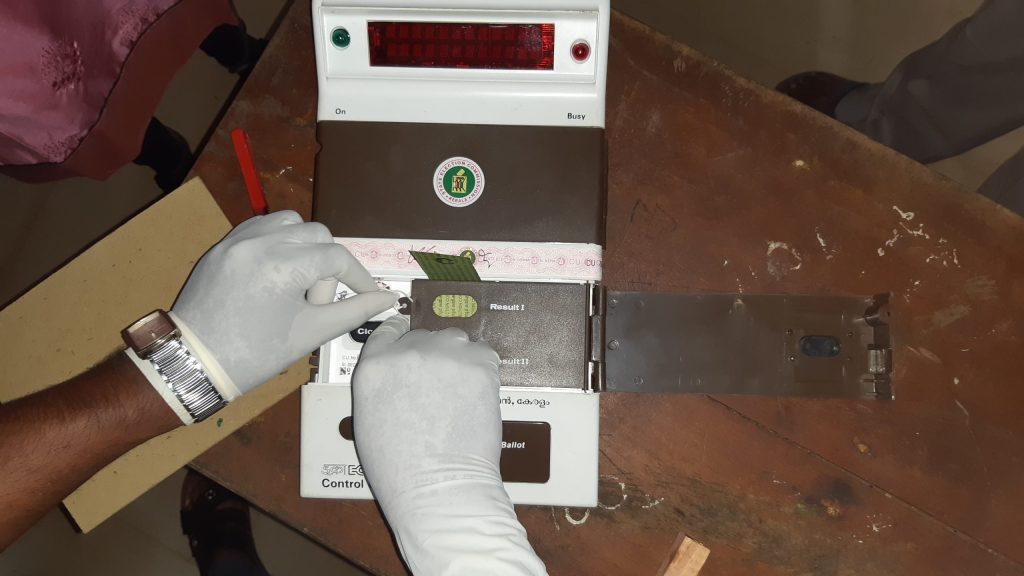
Image: The control unit of an electronic voting machine (file photo). Photo by Shagil Kannur, licensed under CC BY-SA 4.0, via Wikimedia Commons.