


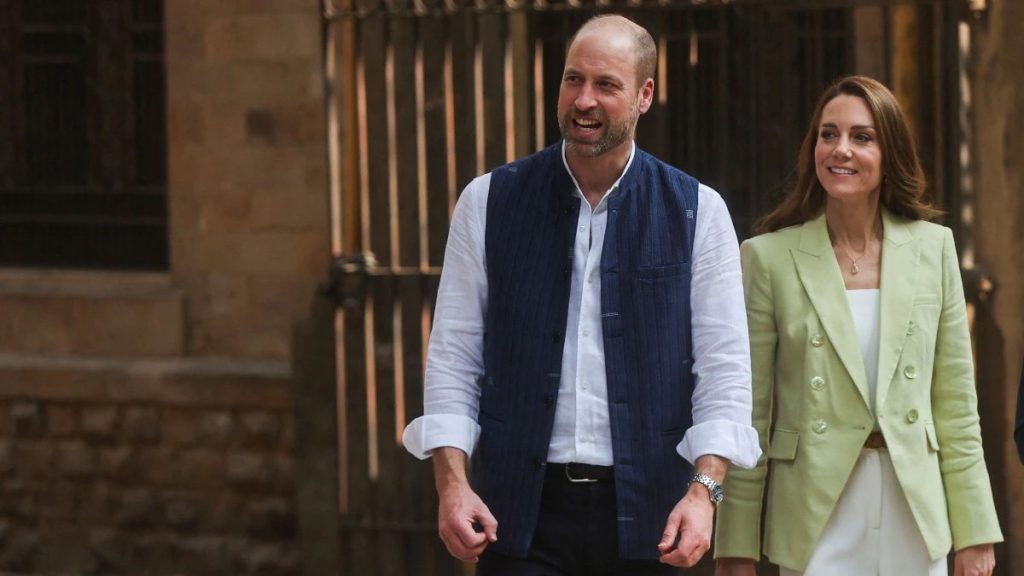
Prince William and Catherine, Princess of Wales, arrived in Mumbai on Monday, 16 November 2026, for a three-day visit to India linked to the sixth edition of the Earthshot Prize, the environmental award launched by Prince William in 2020. The awards ceremony will be held in Mumbai on Tuesday, 17 November, and this is the first time it has been hosted in India. According to The Hindu, the couple will join 5,000 guests, including environmental innovators, business leaders, philanthropists and celebrities, and the royal visit is their first to India together since 2016, when they also travelled to Bhutan.
On the first day, the couple joined a game of gully cricket with young people from communities across Mumbai at Ballard Estate. The Hindu reported that this visit marks the couple's first joint overseas engagement since Catherine announced her cancer diagnosis in 2024, and her first Earthshot Prize since 2022, when the ceremony was held in Boston. A Kensington Palace spokesperson told a media briefing in Mumbai on Sunday that the Prince was "hugely excited to be here", and that for him Earthshot "has always been about urgent optimism", meaning identifying the people who are solving environmental problems and helping those solutions reach more people more quickly. The visit comes with the Earthshot Prize Week, which runs from 13 to 17 November across Jaipur and Mumbai and includes an Impact Assembly in Mumbai on Monday, where Prince William was expected to address innovators, investors and businesses and where new partnerships were due to be announced.
The prize works on a simple model. Every year, 15 finalists are shortlisted across five categories, called Earthshots: Protect and Restore Nature, Clean Our Air, Revive Our Ocean, Build a Waste Free World, and Fix Our Climate. Five winners are chosen, and each receives £1 million, which The Hindu converted at about ₹12.5 crore. The programme aims to recognise 50 winners over a 10-year period. Organisers say that since 2020 they have considered nearly 7,000 nominations from 169 countries. This year, for the first time, major corporations are among the finalists, including India's Mahindra Last Mile Mobility and Denmark's Ørsted.
India occupies a special place in the story. According to The Hindu, the country has produced more finalists and winners than any other since the prize began: of nine Indian finalists so far, four have won, namely Boomitra, Keyti, S4S Technologies and Takachar. Earthshot Prize CEO Jason Knauf told the newspaper that India is "at the forefront of climate solutions" and that its innovations have immediate global application, especially on heat stress. He said past Indian winners had raised 800 million dollars in commercial international investment after winning, and that "what is good for the environment is good for business, and Indian companies are showing that." This year's Indian finalists are Suman Mishra of Mahindra Last Mile Mobility, nominated for affordable electric rickshaws under Clean Our Air, and Bihal Brahmbhatt of the Mahila Housing Trust, nominated for helping some of India's most vulnerable communities tackle extreme heat under Fix Our Climate. Bhutan's Princess Chimi Yangzom Wangchuck and forestry officer Karma Tenzin are also finalists for their work protecting Himalayan forests, which support water systems that sustain 1.6 billion people downstream across South Asia.
The rest of the shortlist shows the range of the prize. Under Protect and Restore Nature, it includes the Indigenous Alliance's support for rangers caring for 270 million hectares of Australian desert and the Yellowstone to Yukon Conservation Initiative's work reconnecting 3,400 km of wilderness across Canada and the United States. In Clean Our Air, Satellites on Fire of Argentina uses forecasts, cameras and satellite technology to protect 92 million hectares across 21 countries from wildfires, and AirQo of Uganda builds affordable air-pollution monitors for African countries. Under Build a Waste Free World, the shortlist includes the Philippines' Mother Earth Foundation, a French movement to ban PFAS, or "forever chemicals", and South Korea's Zero Waste Network, which is credited with helping the country recycle 95 per cent of its food waste, up from 2 per cent in the mid-1990s. The Revive Our Ocean finalists include Niue's Coral Pasisi, the shipping-focused ZEMBA and the city of Barcelona, and under Fix Our Climate are also Pula, which provides insurance to 24 million African farmers, and Ørsted's shift from coal-intensive utilities to renewables.
Beyond the prize itself, the programme is trying to reach young people. The first Children's Earthshot Awards will be held on Tuesday, and organisers said the programme has engaged more than 15,000 schools across 24 Indian states. The Prince and Princess will attend, and Generation Earthshot has brought together 130 young climate leaders from India, Africa, the Asia-Pacific region and Latin America. The ceremony is hosted by filmmaker Karan Johar and features Sachin Tendulkar, Alia Bhatt, Rami Malek, Sonam Kapoor and Simone Ashley, with performances by Take That, Shreya Ghoshal, Shashwat Sachdev and the Mumbai-based all-female hip-hop collective Wild Wild Women, which will perform at the first Earthshot Orchestra. It will stream globally on Prime Video, with organisers citing more than 240 countries and territories and, according to The Hindu, over 40 languages from 30 November.
The case for the event is that it focuses global attention and investment on practical climate solutions at a time when India is dealing with severe air pollution and extreme weather. The British side stressed the diplomatic angle too: Acting British High Commissioner Ben Mellor said India's "ability to innovate and scale solutions makes it a natural home" for the prize, and described growing U.K.-India cooperation across trade, technology, clean energy, education and security. For the finalists, the prize money and the publicity can help scale up projects that otherwise struggle to find funding, and the figures quoted by organisers on past Indian winners suggest the exposure can attract investment.
There are fair questions as well. A celebrity-heavy ceremony may overshadow the solutions it intends to celebrate, and the inclusion of large corporations for the first time raises a debate over whether a prize meant to back innovators should also reward companies that have more resources than most finalists. Whether a single £1 million award, or five of them each year, can change outcomes at the scale of the problems involved is a question no ceremony can answer by itself. The organisers' answer is that the prize is meant to catalyse scale and partnerships and not merely to fund, and the Impact Assembly's new partnership announcements will be the test of that claim.
On Tuesday evening, five of the 15 finalists will be named winners in Mumbai. Whatever the result, the event is a significant moment for India's place in the climate conversation: a country that, as the Earthshot team puts it, is on the frontline of environmental problems it did not cause, and that has produced a disproportionate share of the prize's finalists. For Mumbai, it brings a global spotlight and a royal visit. For the finalists, it is a chance to turn recognition into resources, and for the wider public, it is a reminder that solutions on heat, air, waste, oceans and nature already exist and need scaling up.