


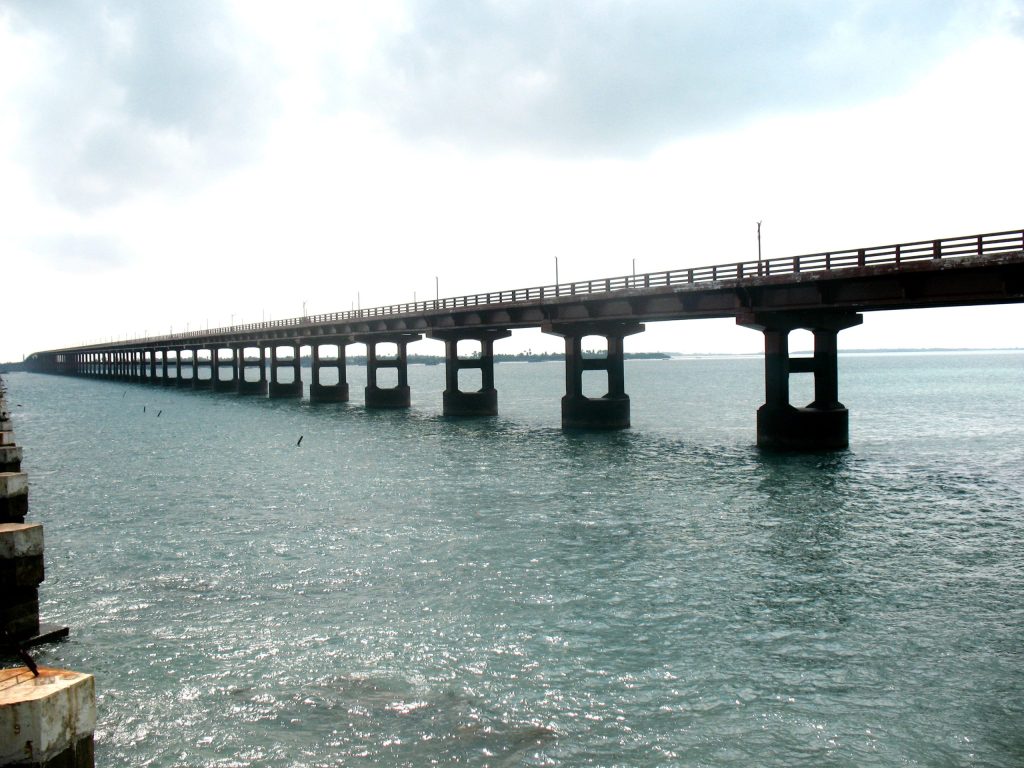

The old Pamban Bridge was a railway bridge that linked the town of Rameswaram, on Pamban Island, with Mandapam on the Indian mainland. It opened on 24 February 1914 and was India’s first sea bridge. It was the longest sea bridge in India until the Bandra–Worli Sea Link opened in 2010.
The idea came in 1870, when the British administration was looking for ways to increase trade with Ceylon. Construction began in August 1911 and finished in time for the opening on 24 February 1914. The bridge crosses a strait 2.06 kilometres wide, in a corrosive marine environment and a cyclone-prone, high-wind zone, which made it a difficult structure to maintain from the start.
The design was a conventional bridge on concrete piers with a movable section in the middle. The railway bridge was 12.5 metres above sea level and 2,065 metres long, resting on 143 piers. The movable part was a double-leaf bascule with a Scherzer rolling-type lift span, which could be raised so that ships and barges could pass beneath. Each half of the lifting span weighed 415 tonnes, and the two leaves were opened manually using levers, taking 45 minutes each to lift and lower.
The bridge was the only surface link between Rameswaram and the mainland until 1988, when a road bridge was built alongside it. A metre-gauge railway ran on the bridge from 1914 until 2007, when it was upgraded to broad gauge.
It was tested by nature. The 1964 Rameswaram cyclone damaged the bridge and it needed extensive repair. In 2009 strengthening work was carried out under the supervision of E. Sreedharan so that it could handle heavier freight trains. In January 2013 a naval barge caused minor damage that required pier repairs. In 2016 the Ministry of Railways sanctioned Rs 250 million to replace the 65.23-metre rolling-type span with a 66-metre single truss span that could be opened automatically. In December 2018 train movement was halted when a fissure was noticed on one span, and services were restored in March 2019.
The end of the old bridge came with corrosion. In 2020 the government announced a new railway bridge nearby at a cost of Rs 2.5 billion, and in December 2022 rail transport on the old bridge was permanently suspended because the bascule section had weakened significantly through corrosion. The new Pamban Bridge was completed in 2024 and opened for traffic in April 2025.
In January 2026 Indian Railways announced plans to dismantle the old bridge, starting with the central span and the bascule section. On 29 January 2026 a crane used in the work collapsed at the mouth of the bridge and had to be righted before the work restarted.
The bridge is notable for the way it served a pilgrimage and trade route. For more than a century it was the main rail connection to Rameswaram, and its manual lift span was a reminder of how much of the early 20th-century engineering depended on human effort.
The story of its structure is a story of maintenance. A well-designed bridge opened in 1914, was repaired many times against the sea, and was retired in 2022 after 108 years, when a replacement was ready.
Featured image: The Pamban Bridge between Rameswaram and the mainland (file photo; this is the old bridge). Photo by Sugeesh at Malayalam Wikipedia, licensed under CC BY-SA 3.0, via Wikimedia Commons.