



In September 1948, just over a year after independence, the Indian Army moved into the princely state of Hyderabad. In five days the forces of its ruler, the Nizam, surrendered, and the largest princely state in the subcontinent became part of India. The action was code-named Operation Polo.
The problem of the princely states
When the British left, more than 500 princely states had to choose between India and Pakistan. Sardar Vallabhbhai Patel, the Home Minister, and his secretary V. P. Menon persuaded nearly all of those inside India’s borders to accede by 15 August 1947. Three held out: Junagadh, Jammu and Kashmir, and Hyderabad.
Hyderabad in 1947
- Size: larger than many European countries, in the heart of the Deccan
- People: about 16 million, the great majority Hindu
- Ruler: Mir Osman Ali Khan, the seventh Nizam, a Muslim and one of the richest men in the world
- His aim: to remain independent, joining neither India nor Pakistan
In November 1947 India and Hyderabad signed a Standstill Agreement for one year, leaving matters as they were while talks continued.
Why talks failed
- The Razakars: A militia led by Qasim Razvi, tied to the Majlis-e-Ittehadul Muslimeen, opposed accession and terrorised villagers and political opponents.
- Telangana: A communist-led peasant uprising was spreading in the countryside.
- Outside help: The Nizam appealed to the United Nations and sought arms abroad.
Patel is said to have called an independent Hyderabad a cancer in the belly of India. Lord Mountbatten, who favoured negotiation, left India in June 1948.
The operation
- 13 September 1948: Indian forces under Major General J. N. Chaudhuri entered the state from several directions, the main thrust coming from Solapur in the west.
- 17 September: The Nizam announced a ceasefire and disbanded the Razakars.
- 18 September: Hyderabad’s army commander, Major General El Edroos, surrendered.
The government called it a “police action”, since it regarded Hyderabad as an internal matter.
The cost
Military casualties were limited. But in the weeks that followed there was widespread violence against Muslims in parts of the state. A committee led by Pandit Sunderlal, sent by the Union government, estimated the dead in the tens of thousands; its report was not made public for decades.
What happened afterwards
- The Nizam was kept as Rajpramukh, the ceremonial head of the state, until 1956.
- Elections were held in 1952.
- In 1956 Hyderabad State was divided on the basis of language among Andhra Pradesh, Bombay State and Mysore State.
- Qasim Razvi was jailed and later went to Pakistan.
17 September is now marked in Telangana, and in the parts of Maharashtra and Karnataka that once belonged to the state, as the day of Hyderabad’s liberation.
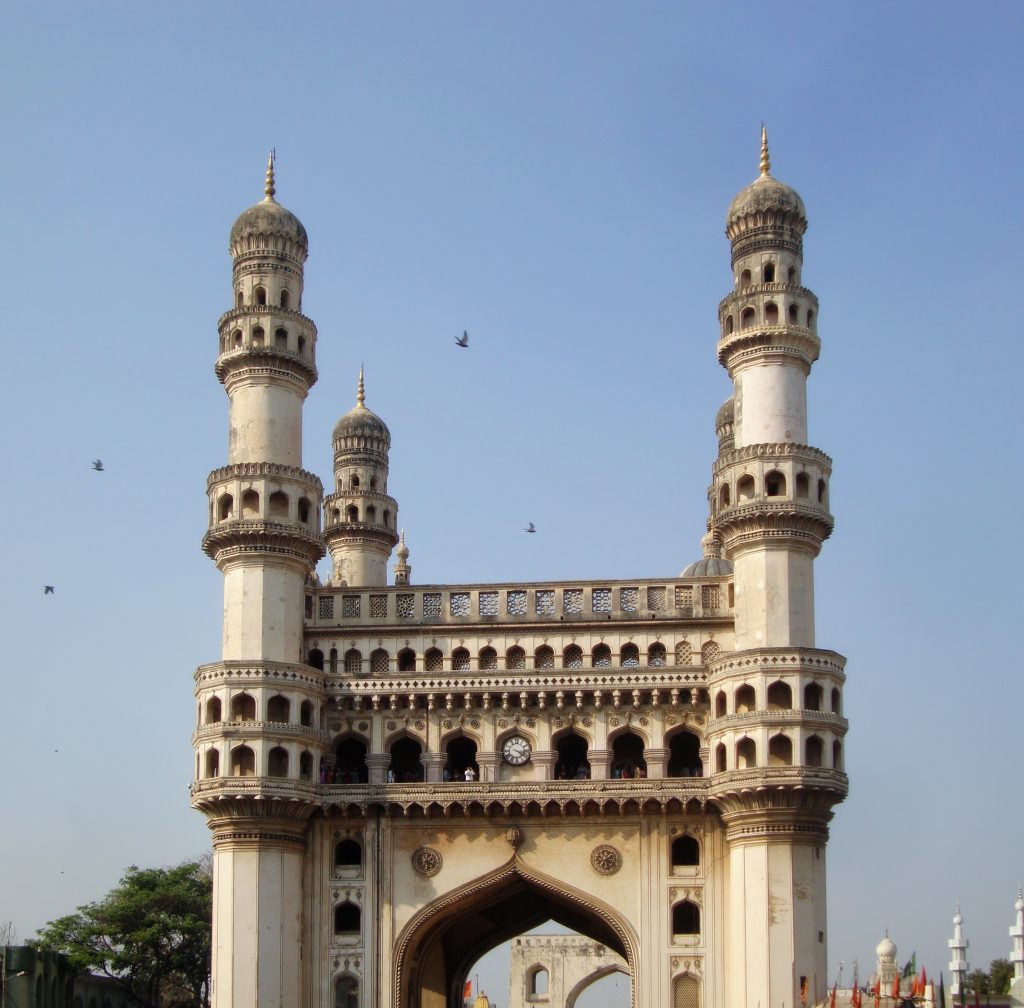
Image: The Charminar in Hyderabad, capital of the former princely state. Photo by Joydeep, licensed under CC BY-SA 3.0, via Wikimedia Commons.