


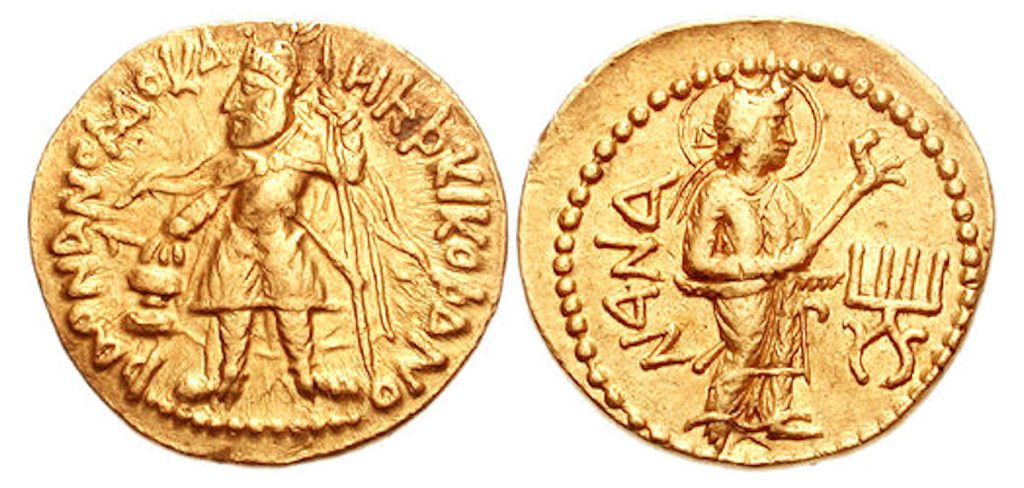

The Kushan Empire, which lasted from about 30 to about 375 CE, was one of the great powers of the ancient world. Formed by the Yuezhi, a people who migrated from north-western China to Bactria, it spread across much of what is now Afghanistan, Pakistan and northern India and into Central Asia. At its heart was the Silk Road, and its emperors, above all Kanishka, left a deep mark on Buddhism and on art.
Quick Facts
| Period | c. 30 – c. 375 CE |
| Founder | Kujula Kadphises |
| Greatest ruler | Kanishka the Great (reigned from about 127 CE, according to Falk) |
| Capitals | Purushapura (Peshawar) and Mathura |
| Languages | Greek at first, then Bactrian |
| Known for | Gold coinage, Gandhara and Mathura art, patronage of Buddhism |
Origins
The Kushans were probably one of five branches of the Yuezhi, an Indo-European nomadic people who settled in Bactria. Kujula Kadphises unified the tribes around the beginning of the first century CE. His successor Vima Kadphises expanded the empire into north-western India and issued gold coins, and the Kushans took on Greek, Iranian and Indian cultural ideas.
Kanishka
Kanishka the Great raised the empire to its height. His domain extended from Central Asia and Gandhara to Pataliputra in the Gangetic plain, and his coins have been found as far as Tripuri near Jabalpur. His main capital was Purushapura, modern Peshawar, with Mathura as a second capital. Around 127 CE he made Bactrian, in place of Greek, the language of administration. Scholars once believed that his accession in 78 CE began the Saka era, but historians no longer accept that date, and place his reign from about 127 to 150.
Religion and Art
Kanishka never converted to Buddhism, but his patronage was important to its spread. According to Buddhist tradition, he sponsored a council of Buddhist scholars, although the place and date are debated, and had a very large stupa built at Peshawar, described by Chinese pilgrims. The Kushan coins show Greek, Iranian, Hindu and Buddhist gods, one of the earliest images of the Buddha among them.
Two art traditions flourished. In Gandhara, a school of sculpture mixing Greek and Roman techniques with Buddhist themes produced some of the earliest images of the Buddha in human form. At Mathura, Indian sculptors produced Buddha images and portraits of Kushan kings in red sandstone.
The Silk Road
The Kushans were in control of the central part of the Silk Road, from Gandhara to China, for more than a century. Their land route over the Karakoram helped carry Mahayana Buddhism from Gandhara to China. They had diplomatic contact with Rome, Persia and Han China, and were at the centre of trade between the Roman world and China, with Indian ports sending goods westward. Some historians describe the period as Pax Kushana.
Decline
In the third century the Sasanians of Persia took the western Kushan territories, and in India the Kushan power fragmented. The Kushan lands in the north-west passed to successor states, and in the fourth century the north was ruled by the Gupta Empire. For a southern contemporary, see the Satavahanas, and for the earlier Buddhist emperor, Ashoka.
Featured image: A coin of the Kushan emperor Kanishka I, with the deity Nana. Photo by CNG Coins, licensed under CC BY-SA 3.0, via Wikimedia Commons.