



Around 261 BCE the Mauryan emperor Ashoka led his army against Kalinga, the coastal kingdom that is now Odisha. He won. What he saw of the cost led him to renounce war and to adopt the teaching of the Buddha. Few battles in history have changed the victor so completely.
Kalinga and the Mauryas
Ashoka’s grandfather, Chandragupta Maurya, had built an empire stretching from Afghanistan to Bengal and deep into the south. Kalinga, on the Bay of Bengal, remained outside it. It was prosperous, with ports that traded across the sea, and it lay across the land and sea routes between the Ganga plain and the south. It had once been part of the earlier Nanda kingdom and had regained its freedom.
Ashoka came to the throne at Pataliputra around 268 BCE. In the eighth year after his consecration he attacked.
What we know
No narrative of the fighting survives. Almost everything known comes from Ashoka himself, in the thirteenth of his Major Rock Edicts, inscribed on rocks across his empire. It says:
- Killed: 100,000
- Deported: 150,000
- Died afterwards: many times that number
The figures may be rounded, but they point to a campaign of great violence against a people who resisted strongly. Tradition places the decisive fighting near Dhauli, on the Daya river south of modern Bhubaneswar.
The emperor’s remorse
The edict is unlike anything else issued by an ancient conqueror. Ashoka, who calls himself “Beloved of the Gods”, says that the killing, death and deportation that take place when an unconquered country is conquered are “extremely grievous”. He regrets the suffering not only of soldiers but of Brahmins, ascetics and householders who lost those they loved.
From then on, he declares, the only conquest he values is conquest by dhamma, by righteousness. He asks his sons and descendants not to think of new conquests by arms.
What changed
- Buddhism: Ashoka became a devoted lay follower, went on pilgrimage to the places of the Buddha’s life and supported the monastic order. Tradition credits him with sending missions that carried Buddhism to Sri Lanka and beyond.
- Dhamma: He promoted a public ethic of non-violence, tolerance among sects, obedience to parents and kindness to servants and animals, and appointed officers to spread it.
- Welfare: He records planting shade trees, digging wells and providing medical care for people and animals.
- Foreign policy: He fought no further wars of conquest.
He did not, however, give Kalinga back. It remained a province of the empire. At Dhauli and at Jaugada, the two sites in Kalinga where his edicts are carved, the edict describing the war is left out; in its place are two special edicts instructing his officials to govern justly and telling the people that the king regards them as his children.
Legacy
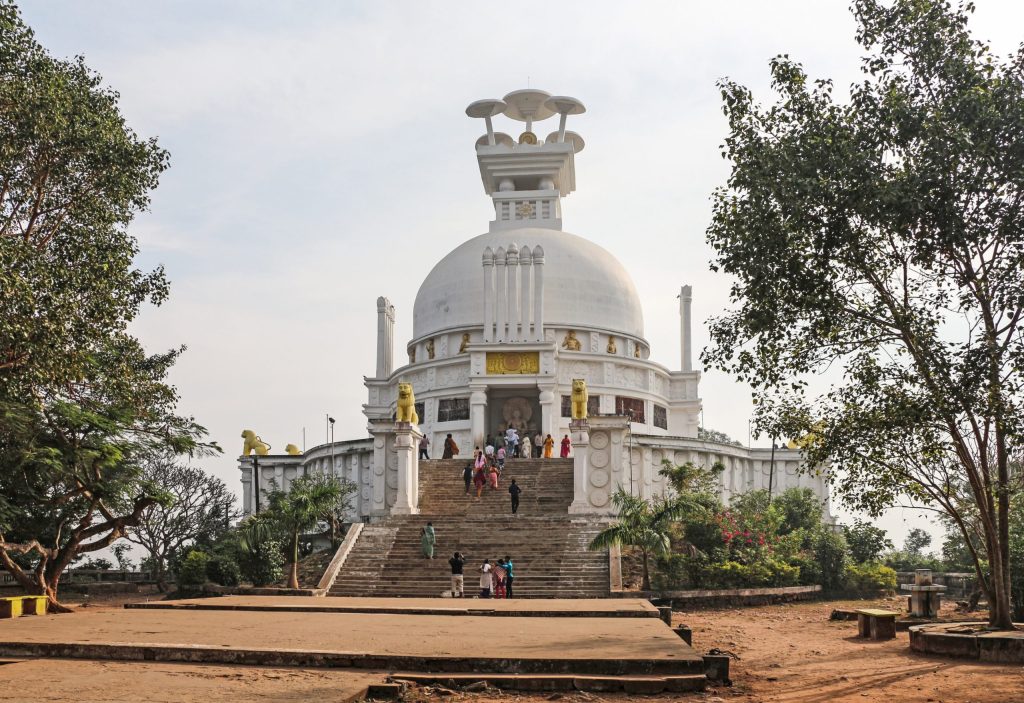
Ashoka was largely forgotten in India until his inscriptions were deciphered by James Prinsep in 1837. Today the lion capital of his pillar at Sarnath is the national emblem, and the wheel from it is at the centre of the national flag. A white peace pagoda, the Shanti Stupa, was built on Dhauli hill in 1972.
Historians note that the Mauryan state kept its army and its punishments, and that the story of an instant conversion on the battlefield comes from later legend. But the edict stands as the emperor’s own public statement of regret for a war he had won.
Image: The Shanti Stupa at Dhauli near Bhubaneswar, the hill traditionally associated with the Kalinga War. Photo by Bernard Gagnon, licensed under CC BY-SA 3.0, via Wikimedia Commons.