


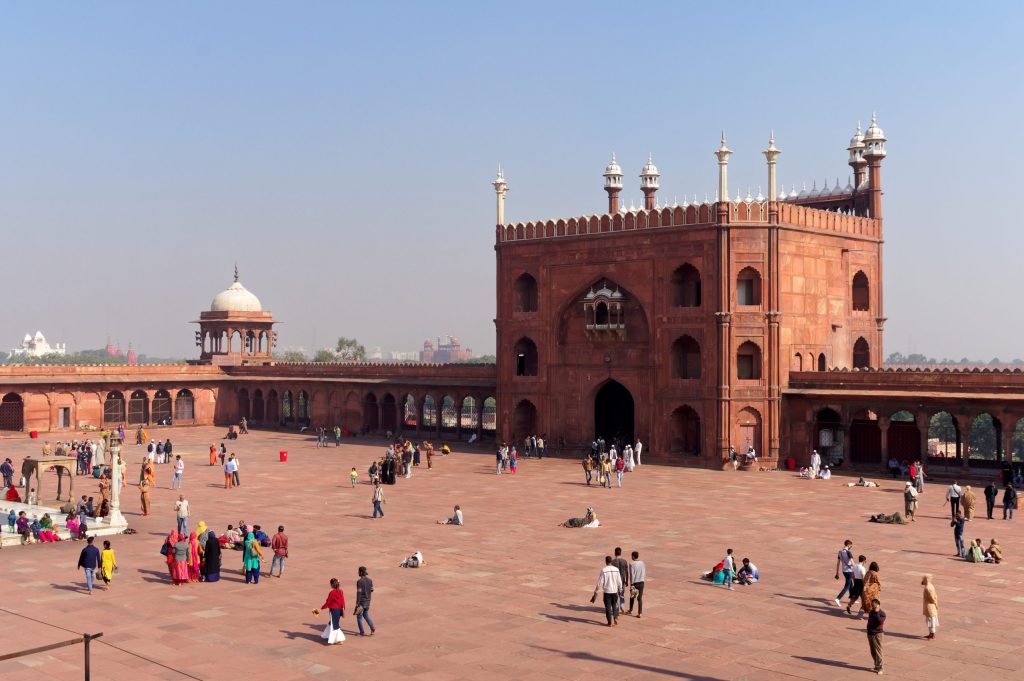

The Jama Masjid in Old Delhi, formally the Masjid-i-Jehan-Numa, is one of the largest mosques in India. It was built by the Mughal emperor Shah Jahan, and it served as the imperial mosque of the Mughal emperors until the end of the empire in 1857. It stands across from the Red Fort, with the Sunehri Masjid nearby, and is a Monument of National Importance.
The two names have different meanings. The older one, bestowed by Shah Jahan, is Masjid-i-Jehan-Numa, interpreted as the “mosque that reflects the whole world”, while Jama Masjid means “congregational mosque”, a general term for a Friday mosque that is used for many mosques around the world.
It was built as part of the emperor’s new capital, Shahjahanabad, at the highest point of the city. Wikipedia gives the construction years as 1650 to 1656 in one place and 1644 to 1656 in another, so the start date varies by source. About 5,000 workers took part, a diverse workforce of Indians, Arabs, Persians, Turks and Europeans, and the work was supervised mainly by the prime minister Sadullah Khan and Fazil Khan, the comptroller of the emperor’s household. The cost was ten lakh rupees. The mosque was inaugurated on 23 July 1656 by Syed Abdul Ghafoor Shah Bukhari, from Bukhara, who had been invited to be the first Shahi Imam.
Shah Jahan said it was modelled on the Jama Masjid of Fatehpur Sikri, which is reflected in the facade and courtyard, while the interior more closely resembles the Jama Masjid in Agra. It was the largest mosque in the subcontinent when completed. Because it stands on a hill, the mosque rests on a platform 10 metres above the city, and the complex faces west toward Mecca. An imperial college, dispensary and madrasa once stood beside it but were destroyed in 1857.
The mosque is reached by three sandstone gates. The eastern gate, three storeys high, was the royal entrance for the emperor and his associates, while the northern and southern gates, two storeys high, were used by the public. Each gate has a three-sided stairway with white markings to show prayer positions.
The courtyard is a square of red sandstone with a side of at least 99 metres and can hold 25,000 worshippers. A marble tank for ablutions, 17 metres by 15 metres, lies in the middle, and open arcades run along the sides, with chhatris at the corners. The prayer hall is 61 metres long and 27 metres wide, with three marble domes topped by golden finials. Its facade has a central pishtaq with five smaller cusped arches on each side, calligraphy above the arches and seven mihrabs on the western wall.
The mosque was a political symbol. The khutba was read in the emperor’s name at Friday prayers, which legitimised his rule, and in 1757 it was read in the name of the Afghan conqueror Ahmad Shah Durrani, who had been invited to Delhi by Alamgir II. It was also a centre of social life in Shahjahanabad, where people of different classes met.
Under the British, who took the city in 1803, the mosque was at first repaired and even renovated. The revolt of 1857 changed this. The British saw the revolt as stirred up in Delhi’s mosques, razed many mosques after retaking the city and banned congregational prayers in the rest, and the Jama Masjid was confiscated for a period.
It remains in active use, closely identified with Old Delhi and surrounded by markets such as Chandni Chowk, and the tomb of Abul Kalam Azad stands next to it. The structure combines a raised site, three gates and a large courtyard, and its design reflects the emperor’s wish to make worship in the capital a public, imperial occasion.
Featured image: The Jama Masjid in Old Delhi (file photo, 2019). Photo by Jakub Hałun, licensed under CC BY-SA 4.0, via Wikimedia Commons.