



On 13 April 1919, British Indian Army troops fired without warning on a peaceful crowd gathered in a walled garden in Amritsar. Hundreds were killed. The Jallianwala Bagh massacre became a turning point in India’s struggle for freedom.
The background
In March 1919 the colonial government passed the Rowlatt Act, which allowed detention without trial. Mahatma Gandhi called for a nationwide protest. In Punjab, where the administration under Lieutenant-Governor Michael O’Dwyer was especially harsh, two popular leaders, Dr Satyapal and Dr Saifuddin Kitchlew, were arrested on 10 April. Protests in Amritsar turned violent and several Europeans were killed. The city was handed over to Brigadier-General Reginald Dyer, who banned public meetings.
The day
- 13 April was Baisakhi, and many villagers had come to the city for the festival, unaware of the ban.
- Several thousand people gathered at Jallianwala Bagh, an open ground enclosed by walls, with only a few narrow exits.
- Dyer arrived with about fifty riflemen, blocked the main entrance and ordered them to fire.
- The firing lasted about ten minutes. Some 1,650 rounds were used, and stopped only when ammunition ran low.
- People were shot as they ran for the exits; many jumped into a well inside the garden.
The toll
The official inquiry counted 379 dead and about 1,200 wounded. The Indian National Congress’s own inquiry put the dead at around 1,000. No medical help was arranged for the wounded, and a curfew kept families away through the night.
What followed
- Martial law: Punjab was placed under martial law, with public floggings and a “crawling order” on one Amritsar street.
- Hunter Commission: The official inquiry censured Dyer, who was removed from command, but he was never prosecuted, and admirers in Britain raised a fund for him.
- Tagore’s protest: Rabindranath Tagore gave up his knighthood.
- Gandhi’s turn: Gandhi, who had cooperated with the British during the First World War, launched the Non-Cooperation Movement in 1920.
- Udham Singh: On 13 March 1940, Udham Singh shot Michael O’Dwyer dead in London. He was hanged that July.
The memorial
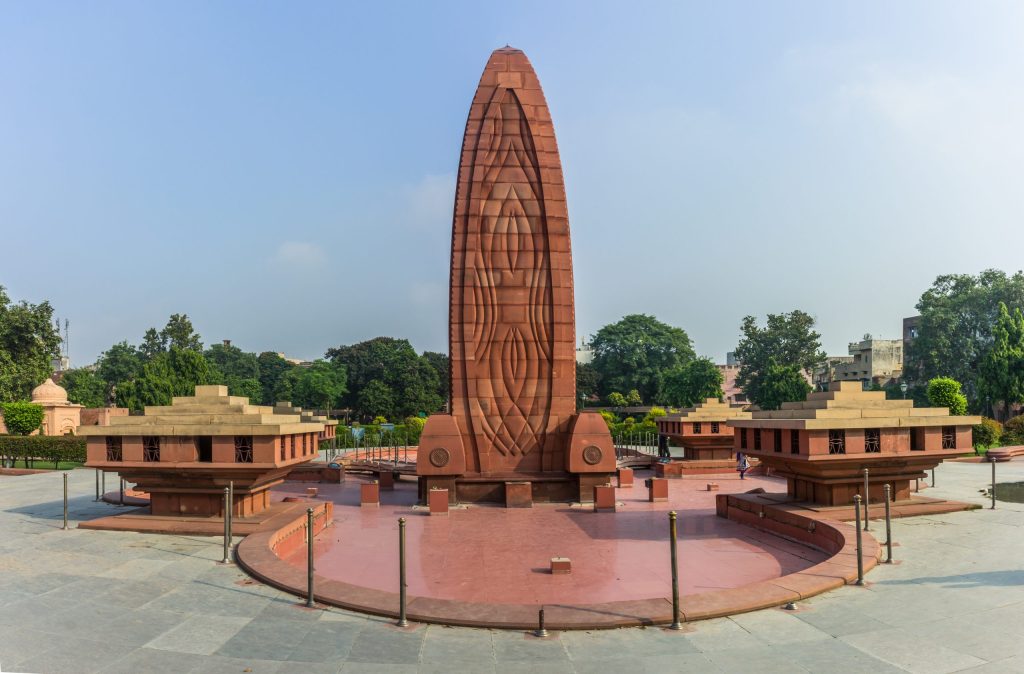
The garden was bought by a public trust in 1920. The memorial there was inaugurated in 1961 by President Rajendra Prasad. Bullet marks on the walls and the Martyrs’ Well have been preserved.
Has Britain apologised?
No formal apology has been made. Queen Elizabeth II visited the site in 1997. In 2013 the British Prime Minister, David Cameron, called the massacre “deeply shameful”, and in 2019, the centenary year, Theresa May expressed “deep regret”.
Image: The memorial at Jallianwala Bagh, Amritsar. Photo by Bijay chaurasia, licensed under CC BY-SA 4.0, via Wikimedia Commons.