


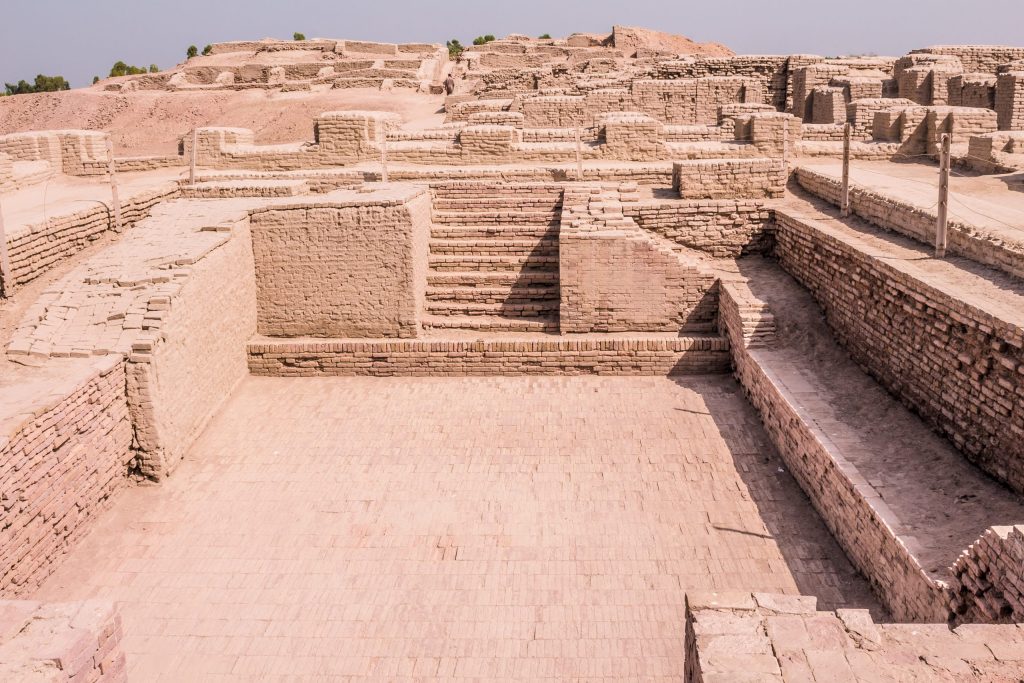

The Indus Valley Civilisation, also called the Harappan Civilisation, was one of the four great centres of the ancient world, alongside Egypt, Mesopotamia and China. It lasted from about 3300 BCE to 1300 BCE, and in its mature form from 2600 to 1900 BCE. It covered a larger area than ancient Egypt and Mesopotamia combined, across what is now Pakistan, north-western India and north-eastern Afghanistan. Its cities had drains and baked-brick houses 4,500 years ago, but its script has still not been read.
Quick Facts
| Period | c. 3300–1300 BCE; Mature phase c. 2600–1900 BCE |
| Region | Indus plains and the Ghaggar-Hakra system: Pakistan, north-western India, Afghanistan |
| Major sites | Harappa, Mohenjo-daro, Dholavira, Lothal, Kalibangan, Rakhigarhi |
| Population | Perhaps one to five million |
| Script | Undeciphered |
Discovery
The Archaeological Survey of India, founded in 1861, began the work that led to the discovery. Harappa, in Punjab (now in Pakistan), was excavated from 1921, and Mohenjo-daro in Sindh from 1922. In 1924 the Director-General of the Survey, John Marshall, announced the finds to the world and showed that India had a Bronze Age urban culture older than anything then known. The civilisation is also called Harappan after the first site found.
Cities and Planning
Harappa and Mohenjo-daro probably held between 30,000 and 60,000 people each. The cities were noted for their planning, baked-brick houses, drainage and water supply.
- **Streets:** laid out on grids, with houses opening on lanes
- **Drains:** covered drains ran along the streets, linked to bathrooms in houses
- **Bricks:** made in a standard ratio, and used across a vast area
- **Public buildings:** the Great Bath at Mohenjo-daro and large granaries are among the largest structures; there is little sign of palaces or temples as known in other early states
- **Dholavira in Gujarat:** a city with an elaborate system of water reservoirs, inscribed as a UNESCO World Heritage Site in 2021
- **Lothal:** often described as a port town with a dock
Trade and Crafts
Harappans made seals, beads of carnelian, pottery and metal goods. Standardised weights suggest regulated trade, and Indus seals and beads have been found in Mesopotamia, which in its texts refers to a land called Meluhha, generally identified with the Indus region. Cotton, copper and bronze were widely used.
The Script
Thousands of inscribed seals carry short signs and animal motifs, but the script is undeciphered. No long text or bilingual inscription has been found, and scholars do not agree on whether it records a language or a set of symbols. Claims of decipherment have not been accepted.
Decline
Around 1900 BCE the cities declined. A gradual drying of the region during the third millennium BCE may have started the process, and changes in the courses of rivers, including the Ghaggar-Hakra, are widely discussed. Scholars now generally favour long-term climate change and shifting settlement over a sudden invasion. The people did not vanish: Late Harappan cultures continued in the villages, and later traditions drew on Harappan ones, though how much is debated.
Why It Matters
The Harappans show that urban life in South Asia began long before the kingdoms of the Gangetic plain, such as the one built by Chandragupta Maurya and Ashoka. Much remains unknown, from the language to the political system, and new digs at sites such as Rakhigarhi in Haryana continue to add to the picture.
Featured image: The Great Bath at Mohenjo-daro in Sindh, one of the best-known structures of the Indus Valley Civilisation. Photo by Soban, licensed under CC BY-SA 3.0, via Wikimedia Commons.