


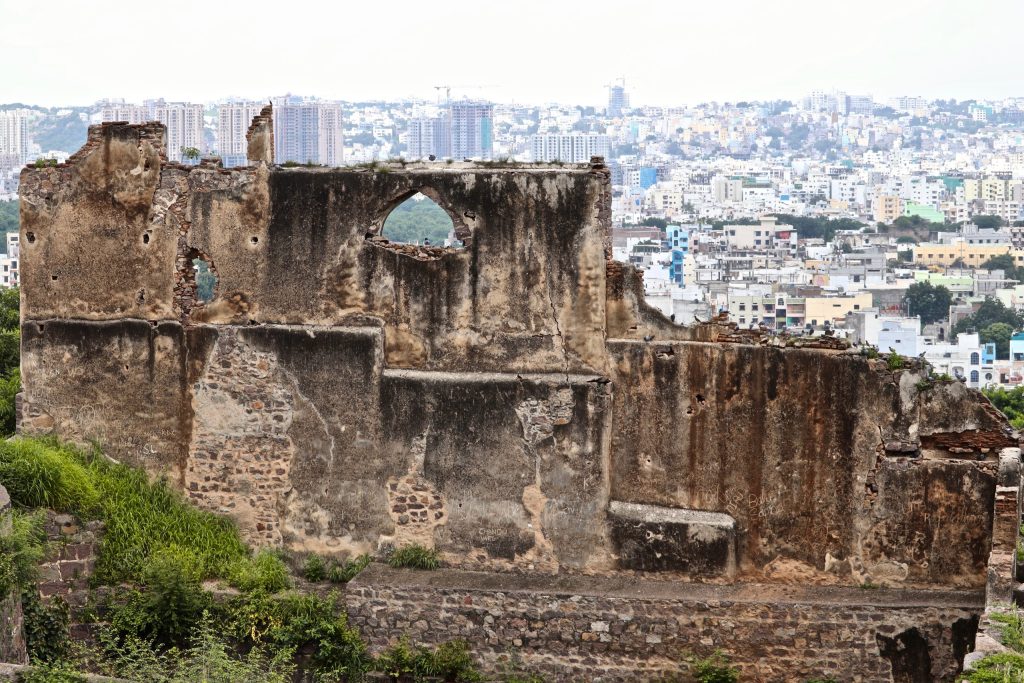

Golconda is a fortified citadel and ruined city on the western edge of Hyderabad, Telangana. Its name is tied to diamonds, and for centuries “Golconda” was a byword for great wealth. The fort that remains today grew in stages from a small mud fort into one of the largest fortifications of the Deccan.
Its origins are in the 11th century, when Wikipedia says a small mud fort was built by Pratāparudra of the Kakatiya dynasty. The name is thought to come from the Telugu Gollakonda, meaning “Shepherd’s hill”. It is also thought that the Kakatiya ruler Ganapati, who ruled from 1199 to 1262, built a stone hilltop outpost to defend the western region. The fort passed to the Bahmani Sultanate, which had received it by a grant from the Raja of Warangal, and the Bahmani governor Quli Qutb Shah, who ruled from 1487 to 1543, made Golconda the seat of his rule around 1501. He became independent in 1518 and founded the Sultanate of Golconda.
Over a period of 62 years the mud fort was expanded by the first three Qutb Shahi sultans into the present structure: a massive granite fortification about 5 kilometres in circumference. Golconda was the capital of the dynasty until 1590, when the capital moved to Hyderabad. The Qutb Shahis expanded the fort until its outer wall, 7 kilometres long in one description, enclosed the city.
As built, Golconda consists of four distinct forts with an outer wall about 10 kilometres long, with 87 semicircular bastions, some still holding cannon, eight gateways and four drawbridges. Inside are royal apartments and halls, temples, mosques, magazines and stables. The Jagdamba temple, next to the mosque of Ibrahim and the king’s palace, is thought to be 900 to 1,000 years old and draws large numbers of devotees during the Bonalu festival. The Qutb Shahi tombs, in Indo-Islamic style within gardens, lie about a kilometre north of the outer wall.
The fort’s wealth came from its position. It stood near diamond mines, particularly the Kollur mine, and Golconda flourished as a trade centre for large diamonds. Stones believed to have come from the mines of Golconda include the Koh-i-Noor, the Hope Diamond, the Regent, the Daria-i-Noor and the Wittelsbach-Graff. The fort is said to have had a vault in which the Koh-i-Noor and the Hope diamond were once stored, though such claims are traditions. A cotton-weaving industry also flourished in the early 17th century, producing muslin and calico for Persia, Europe, Java and Sumatra.
The end came through a siege. In January 1687 the Mughal emperor Aurangzeb led his forces to besiege the Qutb Shahi dynasty at Golconda. After eight months the fort fell, ending the Qutb Shahi rule, and the last king, Abul Hasan Qutb Shah, was taken captive. The diamond mines then brought riches to the Nizam of Hyderabad, who ruled from 1724 after independence from the Mughal Empire until 1948.
The fort is listed as an archaeological treasure by the Archaeological Survey of India. In 2010 India submitted the fort, the Charminar and the Qutb Shahi tombs to UNESCO, and they are on the tentative list, along with other forts of the region under the title Monuments and Forts of the Deccan Sultanate, which was added in 2014. In September 2025 a 1.5-kilometre ropeway between the hilltop fort and the Qutb Shahi tombs was approved under the Parvatmala scheme, with feasibility studies to be carried out.
Golconda’s structure tells a plain story of growth. A small hill outpost was strengthened over six decades into a granite citadel, and a trade centre sat beside it, so that the building of walls and the trade in diamonds shaped each other until the siege of 1687.
Featured image: Golconda Fort with the city of Hyderabad in the background (file photo). Photo by iMahesh, licensed under CC BY-SA 4.0, via Wikimedia Commons.