


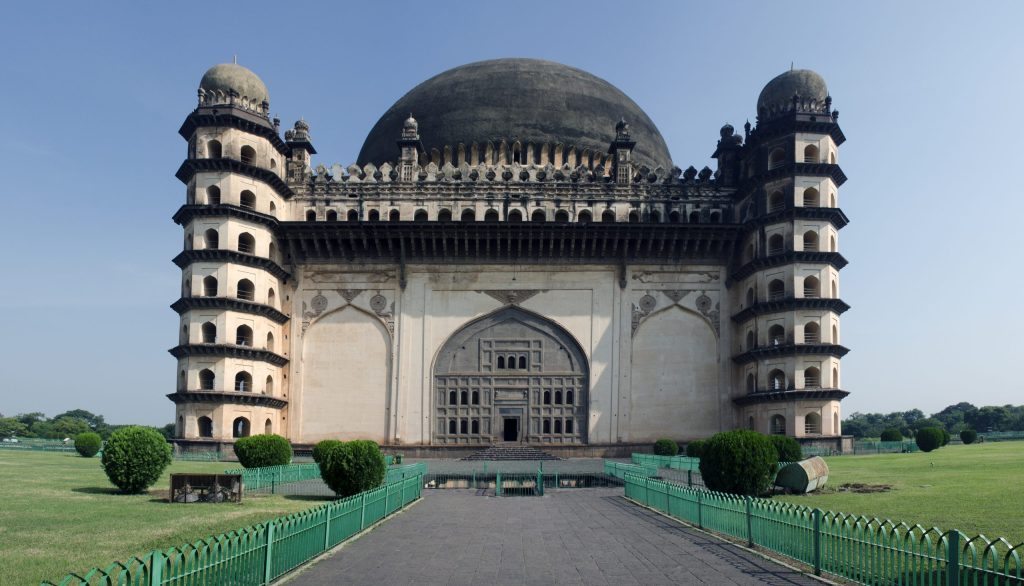

Gol Gumbaz, meaning “Round Dome”, is a mausoleum of dark grey basalt in Bijapur, in northern Karnataka. It holds the tomb of Mohammed Adil Shah, the seventh ruler of the Sultanate of Bijapur, with the tombs of his two wives, a mistress, a daughter and a grandson. It is a prominent example of Indo-Islamic architecture in the Deccan, combining Persian, Mughal and local styles.
The ruler behind it came to the throne in 1627, succeeding his father Ibrahim Adil Shah II, a major patron of the arts. Ibrahim had commissioned a large tomb and prayer hall at Bijapur, the Ibrahim Rauza, which his wife Taj Sultana completed shortly before his death in 1627. Under Mohammed Adil Shah the sultanate reached its greatest territorial extent, and in 1636 he signed a peace treaty with the Mughal emperor Shah Jahan after Shah Jahan conquered the Ahmednagar Sultanate.
Construction began early in his reign and continued until his death in 1656. He intended the tomb to surpass his father’s in size and scale, which continued a tradition among the rulers of Bijapur. The sultan commissioned architects and engineers from different parts of the subcontinent to plan the mausoleum and hired local labourers for decorative work. It was built in three stages: first the foundation and a raised central platform, then the four exterior basalt walls joined by octagonal minarets at each corner, and finally the massive central dome, made of brick and layers of lime mortar. Decoration followed.
The dome is the achievement. Its outer diameter is 44 metres, which made it the largest unsupported dome in India and among the largest domes of the medieval era when it was finished. At the time of the sultan’s death the building was the most technically advanced domed structure in the Deccan and one of the largest single-chamber structures in the world, according to the sources cited. The architectural historian Elizabeth Merklinger suggests that its size was an attempt to assert the stature of the Adil Shahi dynasty at a time of conflict with the Mughals.
An inscription in the tomb records that Mohammed brought a piece of soil from the shrine of Husayn ibn Ali at Karbala and had it placed in the central vault during construction. The site is directly behind the dargah of Hashim Peer Dastagir, a Sufi saint who counted the sultan among his disciples, and the historian Richard Eaton sees this as a sign of their close relationship. The building was not fully complete when the sultan died in 1656, and several decorative elements were left unfinished.
The dynasty then declined under pressure from the Mughals and Marathas. In 1686 Aurangzeb captured Bijapur after a prolonged siege and annexed the sultanate as a Mughal province. The Gol Gumbaz and the tomb complex were largely abandoned in the years that followed, and the city was depopulated by famine, floods and a cholera epidemic.
The monument was rediscovered in the colonial period. In 1891 the Scottish archaeologist Henry Cousens visited Bijapur to establish a museum under the Archaeological Survey, and he described the dome as “one of the greatest domes the world has seen”. In 1892 the British administration opened the Gol Gumbaz Archaeological Museum in the adjacent naqqar khana, or drum house. After independence, management passed to the Archaeological Survey of India in 1962.
Beyond the tomb, the complex includes a mosque, a dargah and the drum house, surrounded by a charbagh garden. The whispering gallery in the central dome has become a popular tourist attraction.
UNESCO included the Gol Gumbaz in the broader group known as Monuments and Forts of the Deccan Sultanate, added to its tentative list in 2014. The tomb remains an example of how rulers used scale to speak about power, even when the structure was finished only partly.
Featured image: The Gol Gumbaz in Bijapur (file photo). Photo by Rangan Datta Wiki, licensed under CC BY-SA 4.0, via Wikimedia Commons.