


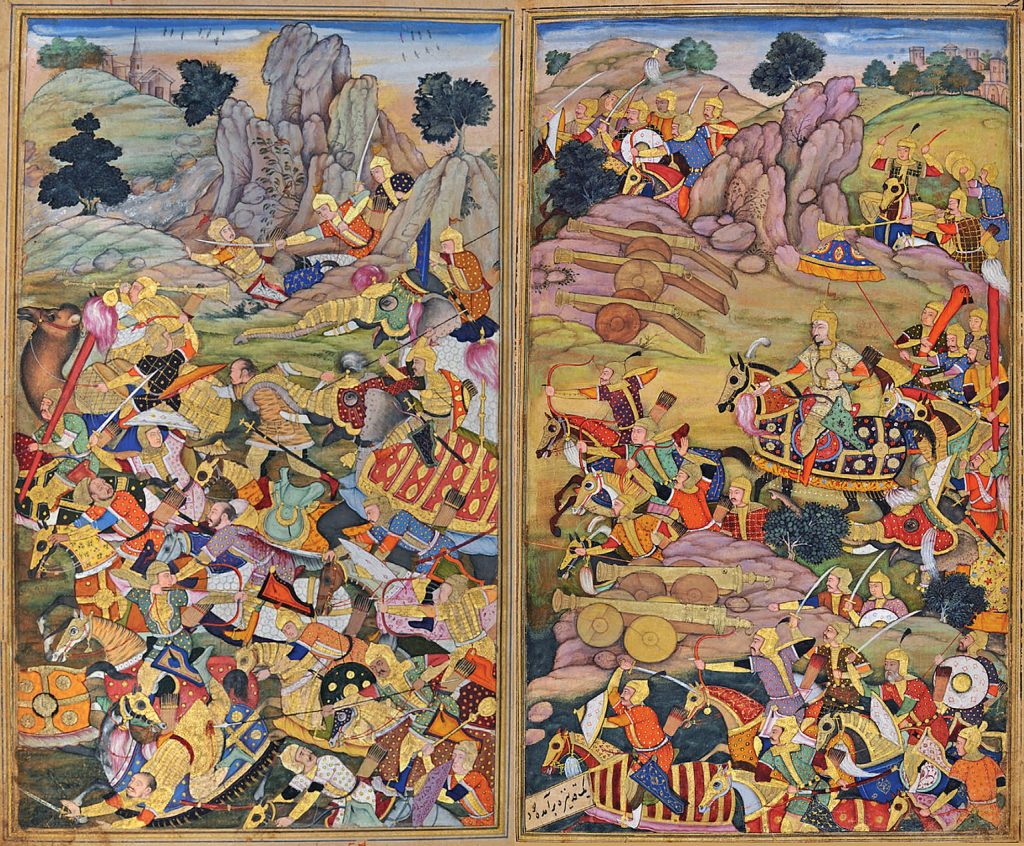

On 21 April 1526, on the plain of Panipat north of Delhi, a Central Asian prince named Babur defeated Ibrahim Lodi, the Sultan of Delhi. The battle lasted a few hours. It ended the Delhi Sultanate and began the Mughal empire.
Babur
Zahir ud-Din Muhammad Babur was descended from Timur on his father’s side and from Chinggis Khan on his mother’s. He inherited the small kingdom of Fergana at eleven, won and lost Samarkand three times, and in 1504 took Kabul. Unable to recover his homeland from the Uzbeks, he turned towards Hindustan, which Timur had once raided.
The Lodi sultanate
Ibrahim Lodi had ruled at Delhi since 1517. His attempts to impose his authority on the Afghan nobles on whom the sultanate depended had driven many into revolt. Daulat Khan Lodi, the governor of Punjab, and Alam Khan, the sultan’s uncle, invited Babur to intervene. Babur came for himself.
The armies
The figures are Babur’s own, from his memoirs.
- Babur: about 12,000 men
- Ibrahim Lodi: about 100,000 men and 1,000 elephants
Modern historians think the sultan’s fighting strength was lower, but he certainly had a large advantage in numbers.
Babur’s plan
Babur had what the sultan lacked: field guns and matchlock muskets, handled by two Ottoman-trained experts, Ustad Ali Quli and Mustafa Rumi. He prepared a position to make the most of them.
- Right flank: the town of Panipat
- Left flank: a ditch and a barrier of felled trees
- Centre: about 700 carts tied together with rawhide ropes, with gaps wide enough for cavalry to ride out; behind them the gunners and matchlockmen, protected by movable shields
- Wings: flanking parties of horse archers, placed to ride round the enemy, the manoeuvre the Mongols called tulughma
For a week the armies faced each other. Babur sent a night raid to provoke the sultan into attacking.
The battle
Ibrahim advanced at dawn. His front, finding the line of carts, checked and crowded together. Babur’s flanking parties swept round both sides and attacked the rear with arrows, while the guns and muskets fired into the packed mass from the front. The elephants, unused to the noise, turned back on their own ranks.
By midday it was over. Ibrahim Lodi was found dead among his men; he is the only Sultan of Delhi to have died on the battlefield. Babur put the enemy dead at 15,000 or more.
After the battle
Babur occupied Delhi and sent his son Humayun to seize the treasury at Agra, where the family of the Raja of Gwalior presented him with a great diamond, often identified with the Koh-i-Noor. Babur distributed the treasure so freely that he was nicknamed the Qalandar, the dervish.
His men wanted to go home from the heat of India. He persuaded them to stay.
Why it mattered
- A new dynasty: The Mughals would rule most of the subcontinent for two centuries and reign in name until 1857.
- A new kind of war: Panipat was the first battle in north India decided by gunpowder weapons used together with field defences and cavalry.
The victory was not yet secure. Within a year Babur had to face the Rajput confederacy of Rana Sanga at Khanwa, a harder fight.
Image: The Battle of Panipat of 1526, from an illustrated manuscript of the Baburnama made in 1598. Photo by an unknown Mughal artist, in the public domain, via Wikimedia Commons.