


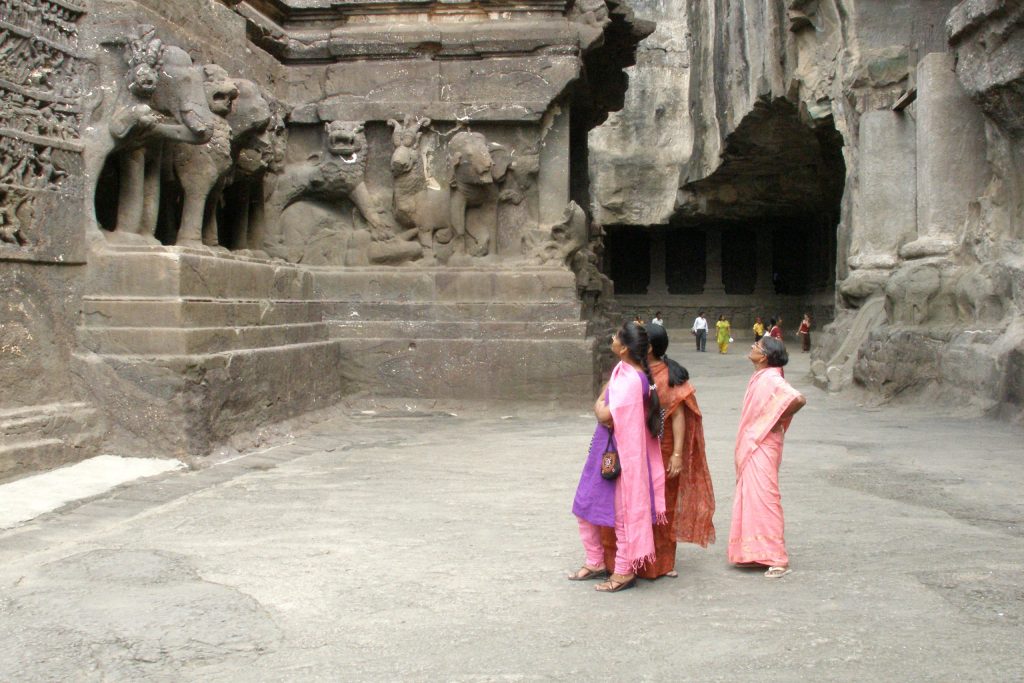

At Ellora, in Maharashtra, thirty-four temples and monasteries were cut out of a basalt cliff over about four centuries. Buddhist, Hindu and Jain monuments stand side by side, and among them is the Kailasa temple, the largest structure ever carved from a single rock. UNESCO inscribed Ellora as a World Heritage Site in 1983.
At a glance
- Location: near Chhatrapati Sambhajinagar (Aurangabad), Maharashtra
- Inscribed: 1983
- Type: Cultural
- Period: about 600 to 1000 CE
- Number of caves: 34, along about two kilometres of cliff
The three groups
- Buddhist caves (1 to 12): the oldest, mostly monasteries. Cave 10, a prayer hall with a seated Buddha before a stupa, is known as the Carpenter’s Cave for its ribbed ceiling.
- Hindu caves (13 to 29): made under the Kalachuri and Rashtrakuta dynasties, with large sculptures of Shiva and Vishnu
- Jain caves (30 to 34): the latest, from the ninth and tenth centuries, smaller and finely detailed
The Kailasa temple
Cave 16 is not a cave but a free-standing temple, dedicated to Shiva and representing his mountain home. It was made in the eighth century under the Rashtrakuta king Krishna I.
- The builders began at the top of the cliff and cut downwards, removing an estimated 200,000 tonnes of rock and leaving the temple standing in the middle of a pit.
- It has a gateway, a pavilion for the bull Nandi, a main shrine with a tower about 30 metres high, and life-size elephants carved around the base.
- Panels show scenes from the Ramayana and the Mahabharata, and Ravana shaking Mount Kailasa.
No mortar or added stone was used. An error could not be corrected.
Why it is a World Heritage Site
UNESCO cites Ellora as a unique artistic achievement and, because sanctuaries of three religions were made together, as an illustration of the spirit of tolerance characteristic of ancient India.
Visiting
Ellora is about 30 kilometres from Chhatrapati Sambhajinagar and is closed on Tuesdays. The Ajanta Caves are about 100 kilometres away.
Image: The Kailasa Temple at Ellora, carved from a single rock. Photo by Vyacheslav Argenberg, licensed under CC BY 4.0, via Wikimedia Commons.