


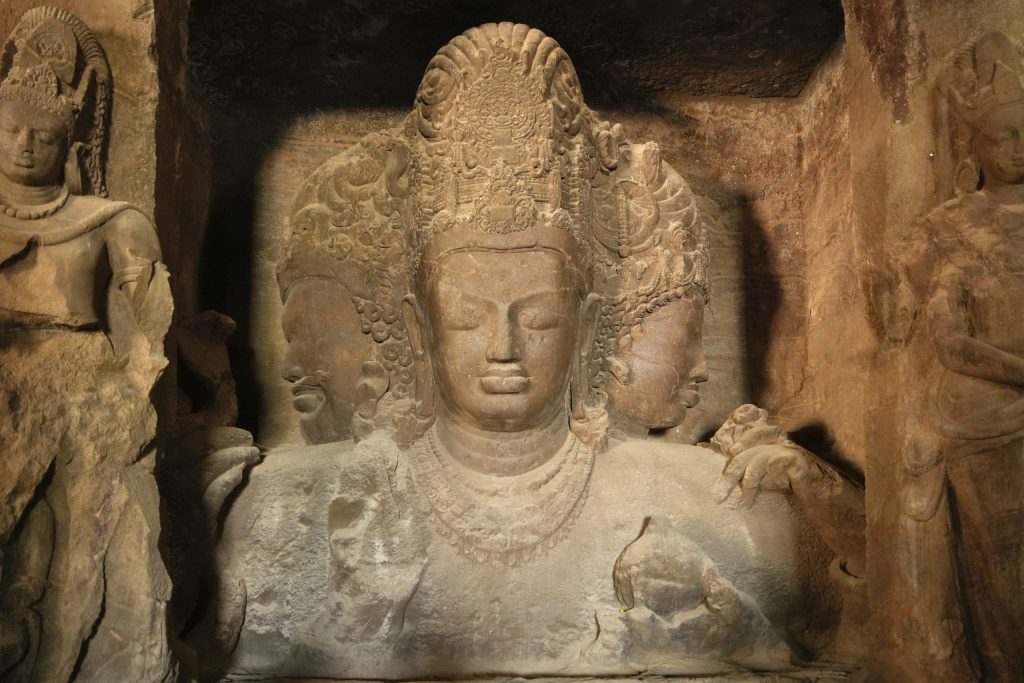

On an island in Mumbai harbour, about ten kilometres from the Gateway of India, a great temple of Shiva was cut into a hillside some fifteen centuries ago. The Elephanta Caves contain some of the most powerful sculpture in India. UNESCO inscribed them as a World Heritage Site in 1987.
At a glance
- Location: Gharapuri island, Raigad district, Maharashtra
- Inscribed: 1987
- Type: Cultural
- Period: about the fifth to sixth centuries CE
- Dedicated to: Shiva
History
The date and the patrons are not known for certain; most scholars place the main cave in the mid-sixth century. The island’s old name is Gharapuri. The Portuguese, who landed in the sixteenth century, named it Elephanta after a large stone elephant on the shore, which now stands in a Mumbai garden. Portuguese soldiers are blamed for much of the damage to the sculptures.
The main cave
The great cave is a pillared hall about 40 metres square, entered from three sides, with a free-standing shrine holding a linga.
- The Trimurti: on the back wall, a bust of Shiva with three heads, about six metres high. The calm central face is the preserver; the fierce face on one side the destroyer; the gentle face on the other the creator.
- Other panels: Shiva as Nataraja, the lord of dance; as Ardhanarishvara, half man and half woman; receiving the river Ganga in his hair; his marriage to Parvati; and Ravana shaking Mount Kailasa
Several smaller caves, including two Buddhist ones, lie elsewhere on the island.
Why it is a World Heritage Site
UNESCO describes the Trimurti and the surrounding reliefs as among the most perfect expressions of Indian art, and the main cave as one of the finest examples of rock-cut architecture in western India.
Visiting
Ferries leave from the Gateway of India and take about an hour. From the jetty there is a walk and a climb of about 120 steps. The caves are closed on Mondays, and boats do not run in rough monsoon weather.
Image: The three-headed figure of Shiva, the Trimurti or Maheshmurti, in the main cave at Elephanta. Photo by Ingo Mehling, licensed under CC BY-SA 4.0, via Wikimedia Commons.