


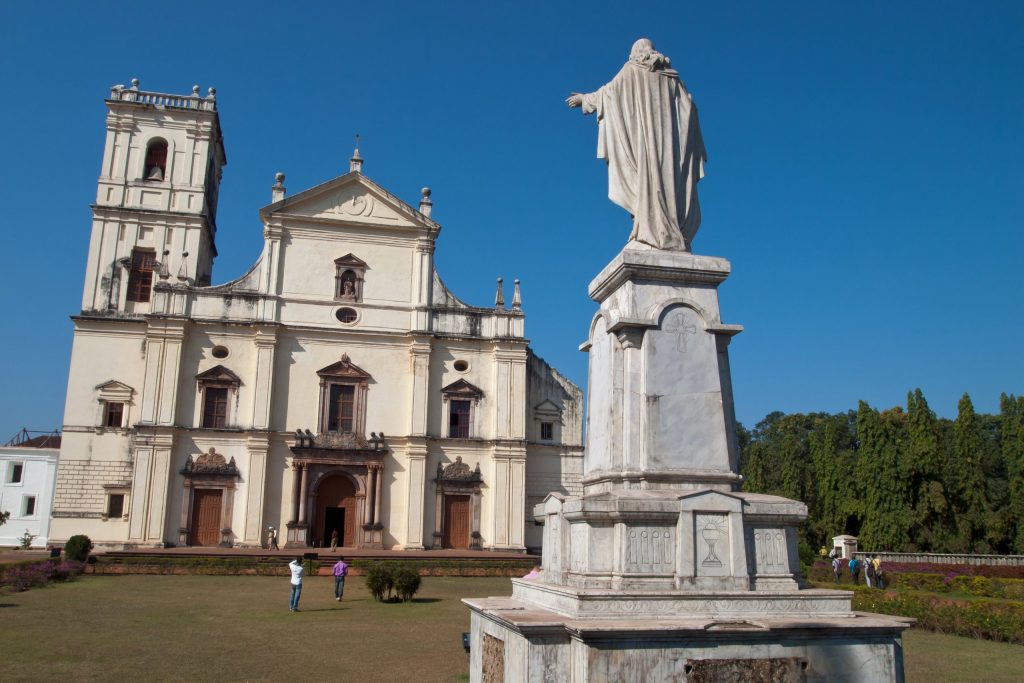

Old Goa, on the Mandovi river about ten kilometres from Panaji, was the capital of the Portuguese empire in Asia. Its houses have vanished, but its great churches remain. UNESCO inscribed the Churches and Convents of Goa as a World Heritage Site in 1986.
At a glance
- Location: Old Goa (Velha Goa), Goa
- Inscribed: 1986
- Type: Cultural
- Period: sixteenth and seventeenth centuries
- Built by: the Portuguese and the Catholic religious orders
History
The Portuguese took Goa in 1510 and made it the seat of their viceroy and of the Catholic Church in the East. At its height the city was said to rival Lisbon. Repeated epidemics drove the population away, and in 1843 the capital was moved to Panaji. Portuguese rule lasted until the liberation of Goa in 1961.
The monuments
- Basilica of Bom Jesus: completed in 1605, with a facade of dark laterite stone. It holds the body of St Francis Xavier, the Jesuit missionary who died in 1552, in a silver casket on a marble tomb given by a Duke of Tuscany. The relics are shown to the public about once in ten years.
- Se Cathedral: built between 1562 and 1619 and among the largest churches in Asia. One of its two towers fell in 1776. Its Golden Bell is renowned for its tone.
- Church of St Francis of Assisi: with a carved and gilded interior; its convent houses an archaeological museum
- Church of St Cajetan: modelled on St Peter’s in Rome
- Chapel of St Catherine and Church of Our Lady of the Rosary: among the oldest, the latter in the Portuguese Manueline style
- Ruins of the Church of St Augustine: a single tall fragment of its tower
Why it is a World Heritage Site
These buildings carried the Manueline, Mannerist and Baroque styles of Europe to Asia, where they were imitated in mission churches from India to Macau. The tomb of St Francis Xavier also marks a major event in the religious history of the continent.
Visiting
The monuments stand close together and can be seen on foot in half a day from Panaji.
Image: The Se Cathedral at Old Goa. Photo by Vyacheslav Argenberg, licensed under CC BY 4.0, via Wikimedia Commons.