


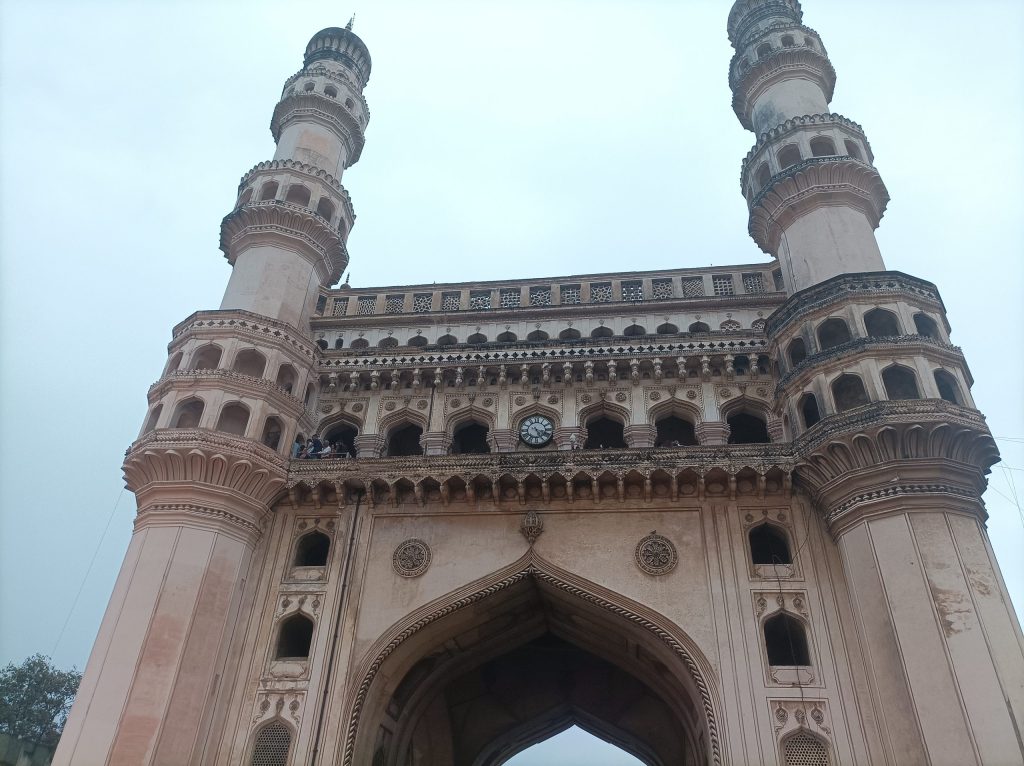

Charminar, whose name means “four minarets”, is the landmark of Hyderabad and is included in the emblem of Telangana. It stands on the east bank of the Musi River, with the Laad Bazaar to its west and the Makkah Masjid to its south-west. It was built in 1591 and was the tallest structure in the city for 396 years, until 1987.
It was built by Muhammad Quli Qutb Shah, the fifth ruler of the Qutb Shahi dynasty, after he shifted his capital from Golconda to the newly founded city of Hyderabad. The reasons for building it are debated. The Archaeological Survey of India says several theories exist, but that it is widely accepted that it was built at the centre of the city to commemorate the end of a plague that was widespread at that time. According to the 17th-century French traveller Jean de Thévenot, it was built to mark the beginning of the second Islamic millennium, the year 1000 AH, which was celebrated across the Islamic world.
Construction began in 1589 and took about two years, at a recorded cost of Rs 9 lakh, which was about 2 lakh gold coins at the time. The foundation was at least 30 feet deep and the structure is said to weigh around 14,000 tonnes. It is made of granite, limestone, mortar and pulverised marble. It was reported that a sample of the Charminar was first built at a graveyard before the actual construction began.
The monument was the centrepiece of the city plan. It was built at the intersection of the trade route that linked the city to the port of Machilipatnam, and the old city was laid out around it in four quadrants. North of it lie the Char Kaman, four gateways in the cardinal directions, and architects from Persia were invited to help develop the plan. It was designed to serve as a mosque and madrasa, in an Indo-Islamic style with Persian elements.
The structure is a square with each side 20 metres long. Each side has a grand arch facing one of the cardinal points and opening onto a street. At each corner stands a 56-metre minaret with a double balcony, crowned by a bulbous dome with petal-like designs at the base. Unlike the minarets of the Taj Mahal, which stand apart, these four fluted minarets are built into the main structure. Visitors climb 149 winding steps to the upper floor.
The structure has four storeys. The mosque occupies the top floor, at the western end of the open roof, and has 45 covered prayer spaces with a large open space in front for Friday prayers. The rest of the roof served as a royal court in Qutb Shahi times. A vaulted ceiling that looks like a dome from inside supports two galleries, and a cistern with a small fountain stands in the middle for ablutions. The clocks on the four sides were added in 1889.
Repairs mark its later history. In 1670 a minaret was struck by lightning and fell, and it was repaired at a cost of about Rs 58,000. In 1820 Sikandar Jah renovated part of it at a cost of Rs 2 lakh.
The area around it adds to the story. The Makkah Masjid next to it is said to have been built with bricks made from soil brought from Mecca for its central arch. The Laad Bazaar is known for bangles and jewellery, and the nearby Pathargatti boulevard is another business street. The Charminar is a site for festivals including Eid.
For all its fame as a symbol of the city, the Charminar is first an architectural answer to a question about how a new capital should announce itself: a gateway, a mosque and a landmark placed at the point where the roads of the new city met.
Featured image: Charminar in Hyderabad (file photo, 2022). Photo by TheAafi, licensed under CC BY-SA 4.0, via Wikimedia Commons.