


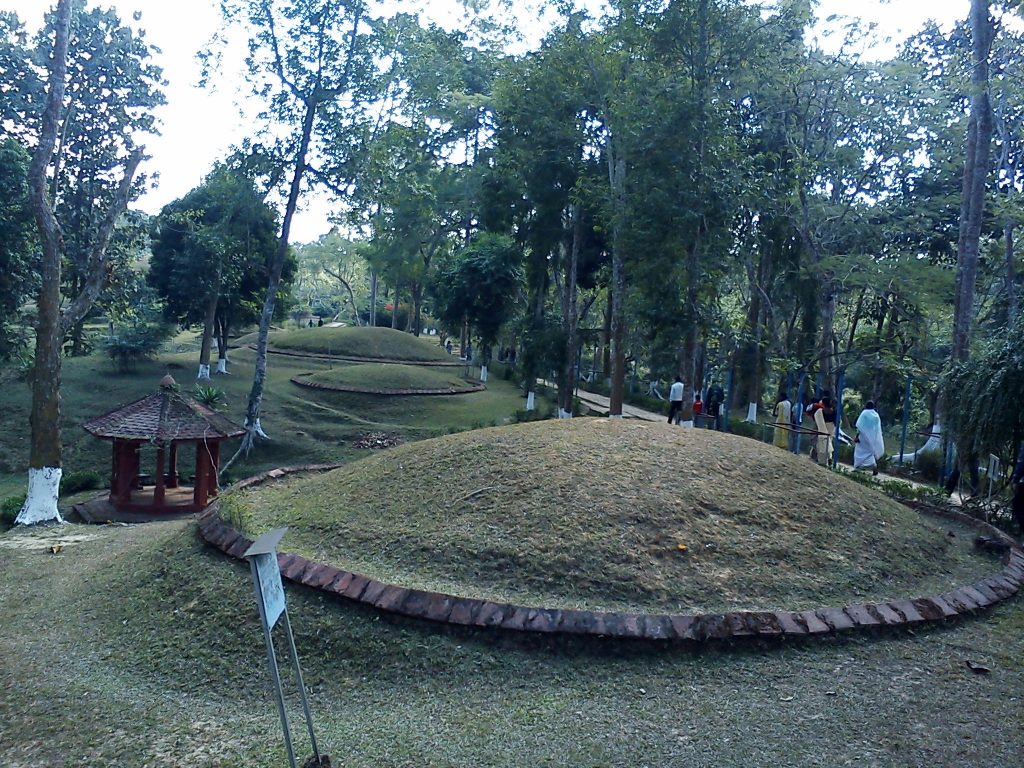

At Charaideo, in the foothills of the Patkai range in eastern Assam, rows of grassy mounds cover the tombs of the kings and queens of the Ahom dynasty. They are sometimes called the pyramids of Assam. UNESCO inscribed the Moidams as a World Heritage Site in July 2024, the first cultural site in north-east India to be listed.
At a glance
- Location: Charaideo district, Assam, about 30 kilometres from Sivasagar
- Inscribed: 2024
- Type: Cultural
- Period: thirteenth to nineteenth centuries
- Number: about 90 moidams within the listed area
The Ahoms
The Ahoms were a Tai people who crossed the Patkai hills from what is now Myanmar under their leader Sukaphaa. In 1253 he established his first capital at Charaideo. His descendants ruled the Brahmaputra valley for nearly six hundred years, until 1826, and repeatedly held off the Mughals, most famously at the Battle of Saraighat.
Though the capital later moved, Charaideo remained the sacred place of the dynasty, where its dead were laid among the ancestors.
How a moidam was made
The Ahoms originally buried their dead, following Tai custom, and continued to do so for their kings even after adopting Hinduism and cremation in later centuries.
- The vault: a chamber of brick, stone or wood, in which the body was placed with ornaments, weapons, clothes and vessels; early chronicles say attendants were buried with the king, a practice later ended
- The mound: a hemisphere of earth heaped over the vault
- The cap: a small open pavilion on the summit, called the chow-chali
- The wall: a low octagonal brick wall round the base, with an arched gateway on the west
The size of the mound reflected the rank and power of the person buried.
Later history
Many moidams were broken into by treasure hunters, beginning with the invasion of Mir Jumla in the seventeenth century. The Archaeological Survey and the state government now protect the group, and several vaults have been excavated.
Living tradition
Descendants of the Ahoms still gather at Charaideo each year for the festival of Me-Dam-Me-Phi, on 31 January, to honour their ancestors.
Why it is a World Heritage Site
The moidams are an outstanding example of a Tai-Ahom burial landscape, showing a funerary tradition maintained for six centuries.
Visiting
Charaideo is reached from Sivasagar, the later Ahom capital, which has its own palaces, temples and great tanks. Dibrugarh and Jorhat have the nearest airports.
Image: Moidams, the burial mounds of the Ahom royalty, at Charaideo, Assam. Photo by Dhruba Jyoti Deka, licensed under CC BY-SA 3.0, via Wikimedia Commons.