


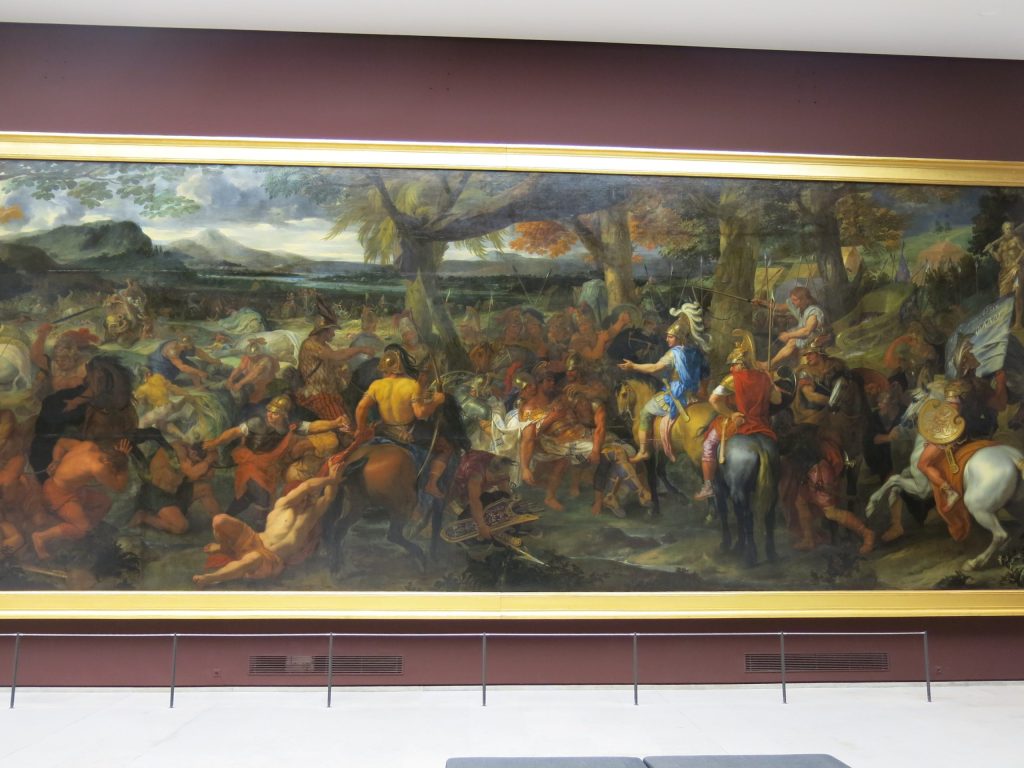

In the summer of 326 BCE, Alexander of Macedon fought the Indian king Porus on the banks of the river the Greeks called the Hydaspes, the Jhelum of today. It was the last major battle of Alexander’s career and, by the accounts of his own historians, one of the hardest.
The background
Alexander had overthrown the Persian empire and marched east through Afghanistan. In 327 BCE he crossed the Hindu Kush into the north-west of the Indian subcontinent. The ruler of Taxila, called Omphis or Ambhi, submitted and joined him. His neighbour and rival Porus, who ruled the land between the Jhelum and the Chenab, refused. Porus is thought to be the Greek form of Puru or Paurava.
The armies
- Alexander: a veteran army of Macedonian infantry and cavalry with allied troops, perhaps 40,000 in the region, of whom a smaller picked force fought the battle
- Porus: by Greek accounts about 30,000 infantry, several thousand cavalry, some 300 chariots and up to 200 war elephants
The crossing
Porus held the far bank, and the river was swollen by the monsoon. Horses would not face elephants while climbing out of the water, so a direct crossing was impossible.
Alexander spent days marching troops up and down the bank with noise and fires until the defenders stopped responding to the alarms. Then, on a night of thunderstorm, he took a picked force about 27 kilometres upstream and crossed by a wooded island. Porus sent his son with chariots to stop them; the chariots stuck in the mud and the prince was killed.
The battle
Porus turned to meet the threat, placing his elephants along the front of his infantry like towers on a wall. Alexander avoided the centre and attacked the Indian cavalry on the wings with his own horsemen, sending a detachment round to strike from behind. The Macedonian infantry then advanced on the elephants, killing the drivers and wounding the animals with javelins. Maddened and hemmed in, the elephants trampled friend and foe alike. The Indian army broke.
“As a king”
Porus fought on from his elephant until he was wounded and exhausted. Brought before Alexander and asked how he wished to be treated, he is said to have replied, “As a king.” Alexander, impressed, gave him back his kingdom and added more territory to it. Porus became his ally.
Alexander founded two cities on the river, one named Bucephala after his horse, which died there.
The turning back
Alexander marched on to the Beas. There his army, worn by eight years of campaigning and the monsoon, and alarmed by reports of the great kingdoms and elephant armies of the Ganga plain, refused to go further. He turned south down the Indus and left India in 325 BCE. He died in Babylon two years later.
What we do not know
Every surviving account, by Arrian, Plutarch, Curtius and Diodorus, was written by Greeks and Romans centuries later. No Indian text of the period mentions Alexander or the battle. Some modern writers have questioned whether the victory was as complete as the Greeks claimed, pointing to how generously Porus was treated.
The aftermath
Within a few years of Alexander’s death, Chandragupta Maurya had taken the north-west and founded the Maurya empire. The contact opened by the invasion left a lasting Greek influence on the art, coinage and astronomy of north-west India.
Image: Alexander and Porus, painted by Charles Le Brun in 1665, now in the Louvre. Photo by Charles Le Brun, in the public domain, via Wikimedia Commons.