


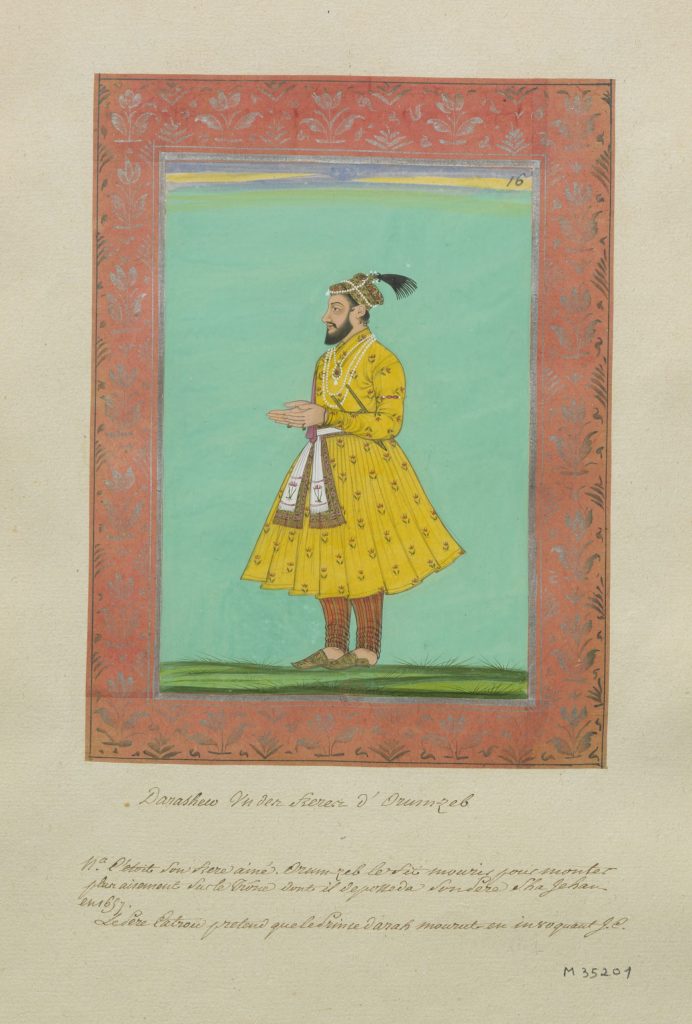

On 29 May 1658, on a scorching plain a few kilometres east of Agra, two sons of the Mughal emperor Shah Jahan fought for their father’s throne. Dara Shikoh, the eldest and the heir, was defeated by Aurangzeb, the third. The Battle of Samugarh decided who would rule India for the next half-century.
The four brothers
The Mughals had no rule of succession; the saying was “takht ya takhta”, the throne or the coffin. Shah Jahan had four adult sons, each governing a province with an army of his own.
- Dara Shikoh, the eldest, lived at court as his father’s favourite. A scholar and mystic, he had the Upanishads translated into Persian and wrote a book arguing that Sufism and Vedanta taught the same truth. He had little experience of war and a gift for making enemies among the nobles.
- Shah Shuja governed Bengal.
- Aurangzeb, governor of the Deccan, was an experienced general, austere, orthodox in religion and patient in intrigue.
- Murad Bakhsh, the youngest, governed Gujarat and was brave and reckless.
The crisis
In September 1657 Shah Jahan fell seriously ill at Delhi. Dara took charge and kept the news close, and rumour spread that the emperor was dead. Shuja and Murad each proclaimed himself emperor. Aurangzeb did not. He made a pact with Murad, promising him a share of the empire, and the two marched north together.
An imperial army under Maharaja Jaswant Singh of Marwar tried to stop them at Dharmat, near Ujjain, on 15 April 1658 and was beaten. The brothers crossed the Chambal by an unguarded ford and approached Agra.
The battle
Dara came out to meet them with a large and splendid army, perhaps 50,000 strong, but one hastily assembled; his best troops were away in the east with his son, fighting Shuja. Shah Jahan, now recovered, wished to go himself and was dissuaded.
The armies met near the village of Samugarh in fierce heat. Dara’s Rajput cavalry made the day’s great effort. Rao Chhatrasal of Bundi and Ram Singh Rathor charged the rebel line; one group cut its way to Murad’s elephant, whose howdah bristled with arrows, and another came close to Aurangzeb, who had his elephant’s legs chained so that it could not turn. The Rajput leaders were killed one after another, and the charges failed.
Dara, on a tall elephant, was a target for rockets and guns. At the critical moment he got down and mounted a horse; by some accounts he was urged to do so by an officer, Khalilullah Khan, who was in league with Aurangzeb. His men, seeing the howdah empty, concluded that he had fallen. The army dissolved. Dara fled to Agra and then towards Delhi and Lahore.
The victor
Aurangzeb occupied Agra, refused to visit his father, and confined him in the fort, where Shah Jahan lived for eight years within sight of the Taj Mahal. A few weeks later Aurangzeb invited Murad to a feast, had him arrested, and later executed. He was crowned at Delhi in July 1658.
The fate of the others
- Dara raised another army and was beaten at Deorai, near Ajmer, in March 1659. A chieftain whom he had once saved from execution betrayed him. He was paraded through Delhi on a dirty elephant, tried as a heretic and killed in August 1659.
- Shuja was defeated at Khajwa and fled to Arakan in Burma, where he disappeared.
What might have been
Historians have long asked how India would have fared under Dara. Aurangzeb expanded the empire to its greatest extent, but his long wars in the Deccan and his religious policies strained it, and it broke up soon after his death in 1707. Whether the tolerant but impolitic Dara could have held it together at all is a question without an answer.
Image: Prince Dara Shikoh, in a Mughal portrait of the seventeenth century. Photo by an unknown Mughal artist, in the public domain, via Wikimedia Commons.