


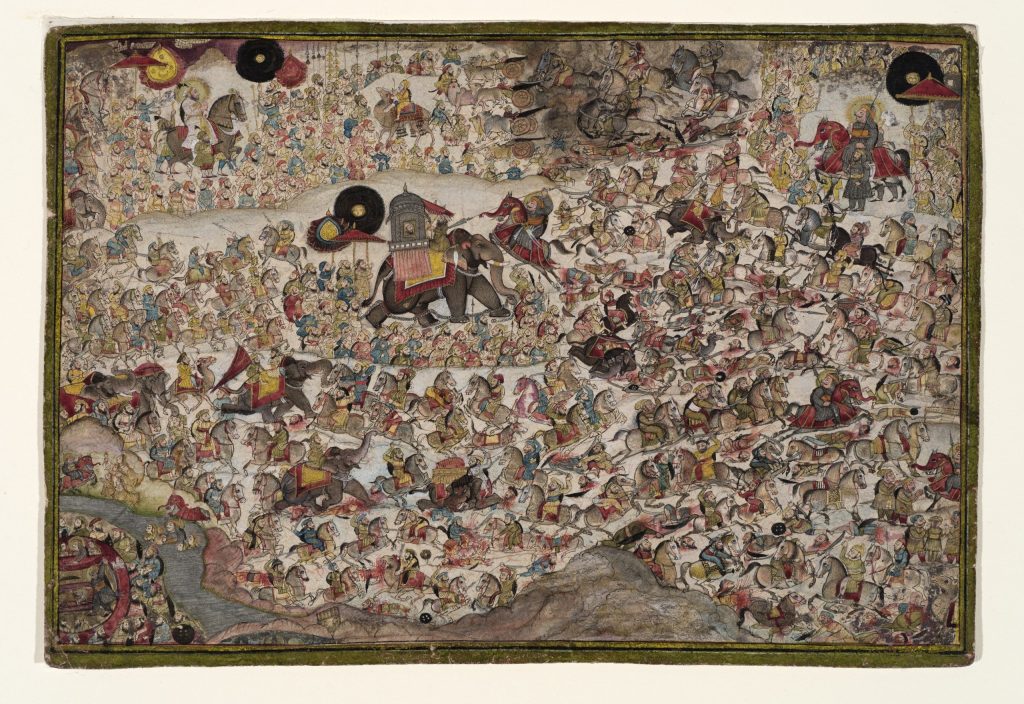

On 18 June 1576, in a narrow pass in the Aravalli hills of Rajasthan, Maharana Pratap of Mewar fought an army sent by the Mughal emperor Akbar. The battle lasted about four hours. It settled little at the time, but it became one of the most celebrated events in Indian memory.
Mewar and the Mughals
Akbar built his empire as much by alliance as by war. One after another the Rajput houses, Amber, Bikaner, Jaisalmer, Marwar, accepted his supremacy, gave daughters in marriage and received high commands. Mewar, the senior Rajput state, did not. In 1568 Akbar captured its capital, Chittor, after a siege that ended in a massacre. The ruler, Udai Singh, withdrew to the hills and founded Udaipur.
His son Pratap Singh succeeded in 1572. Akbar sent four embassies, among them missions led by Man Singh of Amber and Raja Todar Mal, to persuade him to submit. Pratap received them courteously and refused to attend the imperial court in person. For Akbar, an independent Mewar also blocked the road from Delhi to the ports of Gujarat.
The armies
- Mughal: commanded by Kunwar Man Singh of Amber, with perhaps 5,000 to 10,000 men, including Rajputs of Amber, the Sayyids of Barha and Central Asian cavalry
- Mewar: about 3,000 cavalry, a few elephants and some 400 Bhil archers under their chief Punja. Pratap’s vanguard was led by Hakim Khan Sur, an Afghan.
Rajputs and Muslims fought on both sides. It was a war between an empire and a kingdom, not between religions.
The battle
Man Singh camped near the village of Khamnor, at the mouth of the pass of Haldighati, so named for its turmeric-yellow soil. Pratap came out of the hills and attacked.
The first Mewar charge broke the Mughal vanguard and left wing, which fled for some distance. The Mughal right and centre held. A rumour, perhaps spread deliberately, that Akbar himself was arriving with reinforcements steadied the imperial troops, and their reserve came up.
In the centre Pratap, riding his horse Chetak, attacked Man Singh on his elephant. His lance missed Man Singh and killed the driver; the elephant’s tusk-blade wounded Chetak in the leg. Pratap himself was wounded. As the Mughals closed round him, a chief named Jhala Man, or Bida, took the royal umbrella over himself to draw the enemy, and was killed while Pratap was led away.
Chetak carried his master clear of the field, leapt a stream and died. A memorial stands at the spot.
Who won?
The Mughals held the ground, and Pratap’s army withdrew with heavier losses; by that measure it was an imperial victory. But Man Singh did not pursue into the hills, failed to capture or kill Pratap, and soon ran short of food in the hostile country. Akbar showed his displeasure by barring him from court for a time. In recent years some writers in Rajasthan have argued that Pratap should be considered the victor, a view most historians do not accept.
The long resistance
Pratap fought on from the hills for twenty years, living at times in great hardship, supported by the Bhils and financed by his minister Bhama Shah. Akbar sent several more expeditions and came once himself without success. After 1579 revolts elsewhere drew the Mughal armies away. In 1582 Pratap won a notable victory at Dewair, and by the time of his death in 1597 he had recovered most of Mewar except Chittor and Mandalgarh.
His son Amar Singh made peace with the emperor Jahangir in 1615 on honourable terms: the ruler of Mewar was never required to attend the Mughal court in person.
The memory
Maharana Pratap became a symbol of refusal to submit, celebrated in ballads, in the work of the historian James Tod and later by the nationalist movement. His equestrian statue stands outside Parliament in New Delhi.
Image: The Battle of Haldighati, painted by the Mewar artist Chokha about 1810. Photo by Chokha, in the public domain, via Wikimedia Commons.