


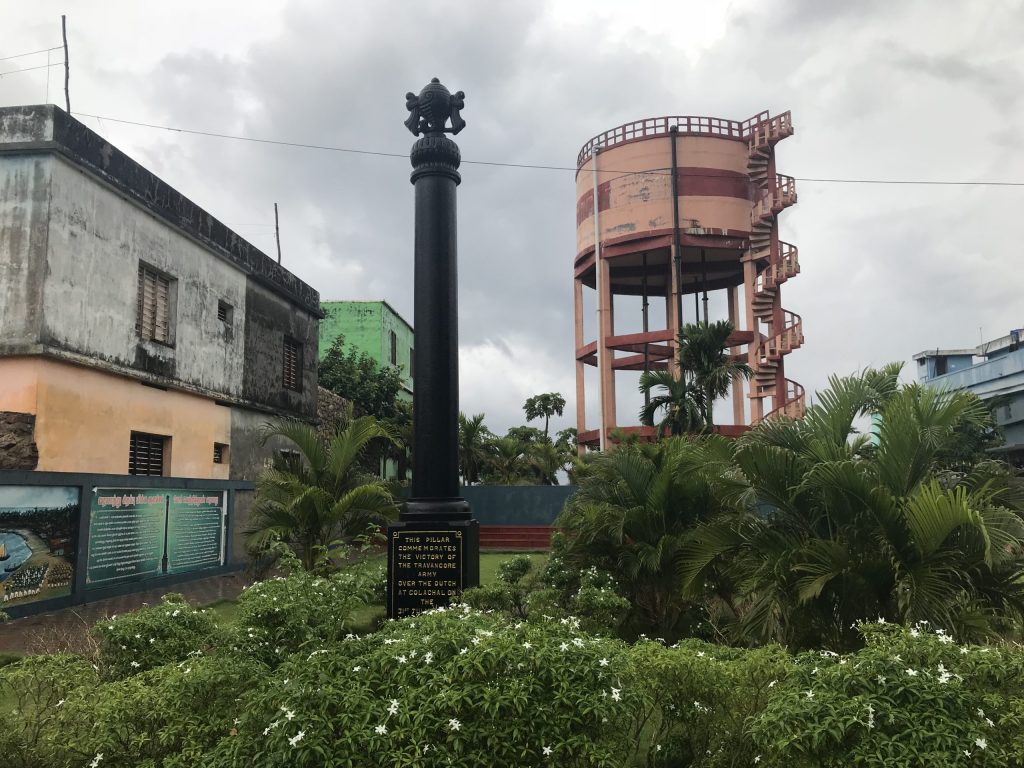

In August 1741, at the small port of Colachel near the southern tip of India, the army of the kingdom of Travancore defeated a force of the Dutch East India Company. It was among the first clear victories of an Indian state over a European power in the colonial age, and it ended Dutch ambitions on the Malabar coast.
Pepper and power
The Dutch East India Company, the VOC, was then the strongest European trading power in Asia. It had taken Cochin and the other Portuguese forts of Kerala in the 1660s, and held treaties with the small coastal states that gave it the pepper crop at fixed low prices.
Marthanda Varma became ruler of the little state of Venad, in the far south, in 1729. He broke the power of the feudal nobles at home and then began to annex his neighbours to the north, Quilon, Kayamkulam and others, forming the kingdom of Travancore. Each conquest took pepper lands out of the Dutch system, since the king sold to whoever paid most, including the English.
The quarrel
The Dutch governor of Ceylon, Gustaaf Willem van Imhoff, came to the king in 1739 to demand that he restore the conquered states. The meeting went badly. Van Imhoff is said to have threatened to invade Travancore; the king replied that if he did so, he would consider invading Europe with his fishing boats.
War followed. The Dutch won some early engagements in the north. Then, to strike at the heart of the kingdom, they sent an expedition from Ceylon by sea.
The landing
Late in 1740 Dutch soldiers landed at Colachel, about twenty kilometres from the Travancore capital at Padmanabhapuram, fortified a position on the shore and advanced, taking villages and coming close to the capital. The king was away in the north. He hurried back with his army, and his minister Ramayyan Dalawa organised the defence.
The battle
The Travancore forces blockaded the Dutch position by land for several weeks. The local fishermen helped by watching the sea and, it is said, by setting up rows of palm trunks on carts to look like cannon. The monsoon broke, and the Dutch ships could neither supply the garrison properly nor bring reinforcements.
The final attack came in early August; 10 August 1741 is the date usually given. Travancore’s infantry and cavalry assaulted the Dutch lines, and a shot set fire to the garrison’s store of rice and powder. The Dutch surrendered. Twenty-four European officers and soldiers were taken prisoner, with muskets and several cannon. The numbers engaged were small, but the effect was large.
De Lannoy
Among the prisoners was a Flemish officer, Eustachius de Lannoy. Marthanda Varma offered him service, and he accepted. Over the next three decades De Lannoy, known in Travancore as the Valiya Kappithan, the Great Captain, trained the army in European drill, set up a foundry for guns at Udayagiri and built a chain of forts and the defensive lines in the north. He is buried at Udayagiri fort.
With this army Travancore annexed the remaining states up to Cochin. In 1750 the king dedicated his kingdom to the deity Padmanabha and ruled thereafter as the god’s servant.
The peace
The Dutch, their trade ruined by the war, signed the Treaty of Mavelikkara in 1753. They undertook not to interfere in the affairs of the Kerala states and to sell Travancore arms. They never recovered their position, and their settlements passed to the British in 1795.
Remembrance
A victory pillar stands near the beach at Colachel. The Indian Army’s Madras Regiment, one of whose battalions descends from the Travancore state forces, observes the anniversary as Colachel Day.
Half a century later De Lannoy’s defensive lines helped Travancore to hold off Tipu Sultan of Mysore, the ruler whose own end came at Seringapatam.
Image: The pillar at Colachel commemorating Travancore’s victory over the Dutch in 1741. Photo by SAJEEVJINO, licensed under CC BY-SA 4.0, via Wikimedia Commons.