



Mahatma Gandhi was shot dead on the evening of 30 January 1948 as he walked to a prayer meeting in New Delhi. He was 78. India had been independent for less than six months.
The last months
Independence had come with Partition and mass killing. Gandhi spent his last months trying to stop the violence, first in Calcutta and then in Delhi. On 13 January 1948 he began a fast to restore peace in the capital and to press the government to pay Pakistan its agreed share of undivided India’s cash balances. He ended it on 18 January after leaders of all communities pledged to keep the peace.
The first attempt
On 20 January a bomb exploded near his prayer meeting at Birla House. A young refugee, Madanlal Pahwa, was caught. Gandhi refused extra security and would not allow those attending his prayers to be searched.
30 January 1948
Gandhi was staying at Birla House on Albuquerque Road. That afternoon he met Vallabhbhai Patel and ran a few minutes late for evening prayers. At about 5.17 pm, as he crossed the lawn leaning on his grandnieces Manu and Abha, a man stepped forward, bowed, and fired three shots into his chest at close range. Gandhi died within minutes.
The assassin, Nathuram Godse, a newspaper editor from Poona and a Hindu nationalist, was seized on the spot.
That night Jawaharlal Nehru told the country by radio: “The light has gone out of our lives and there is darkness everywhere.”
The funeral
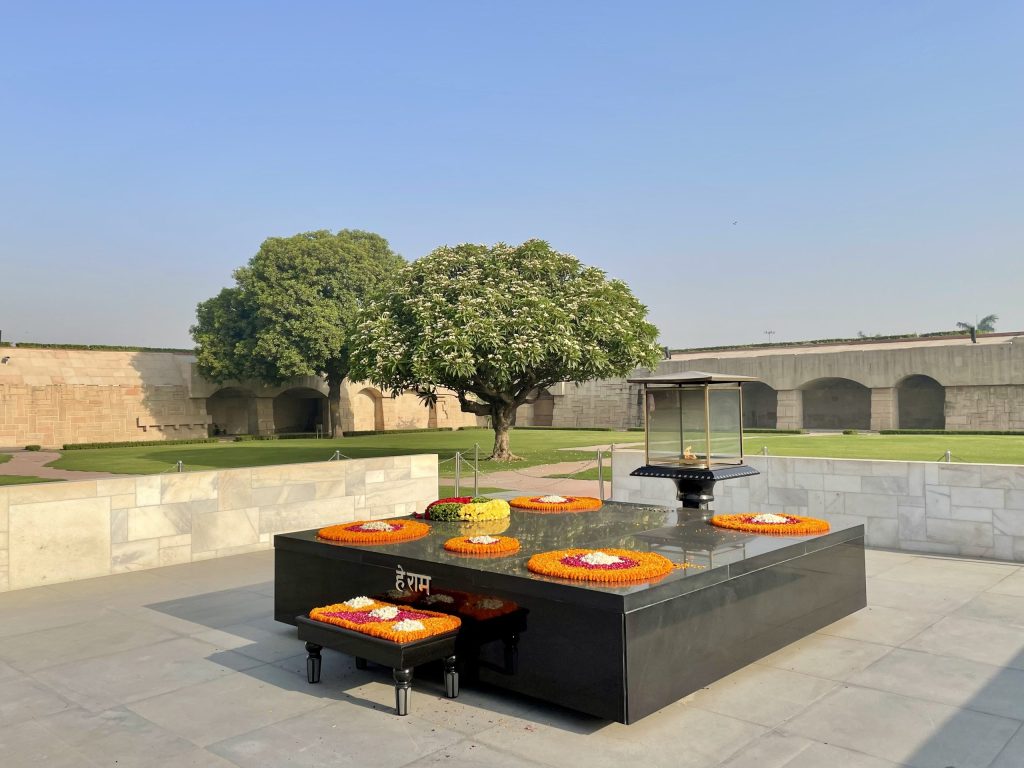
On 31 January a procession of several hours carried the body to the bank of the Yamuna, where it was cremated before a vast crowd. The site is now Raj Ghat.
The trial
- Court: a special court sitting at the Red Fort in Delhi
- Accused: eight men, including Godse, Narayan Apte and V. D. Savarkar
- Verdict: Godse and Apte were sentenced to death; five others received life sentences, two of whom were later acquitted on appeal; Savarkar was acquitted for lack of evidence
- Execution: Godse and Apte were hanged at Ambala jail on 15 November 1949
In court Godse said he held Gandhi responsible for Partition and for favouring Muslims.
The aftermath
The government banned the Rashtriya Swayamsevak Sangh in February 1948; the ban was lifted in July 1949. The shock of the killing helped bring the communal violence in north India to an end.
How it is remembered
30 January is observed as Martyrs’ Day, with two minutes’ silence at 11 am. Birla House is now Gandhi Smriti, a museum where his last steps are marked on the path.
Image: Raj Ghat in New Delhi, where Mahatma Gandhi was cremated on 31 January 1948. Photo by Mbigul, licensed under CC BY-SA 4.0, via Wikimedia Commons.