


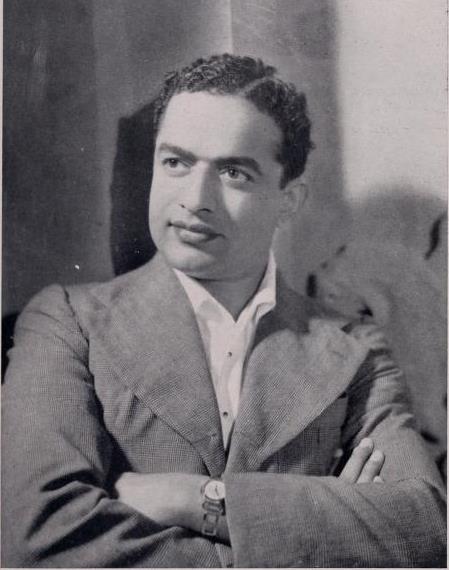

Shantaram Rajaram Vankudre (18 November 1901 – 30 October 1990), known as V. Shantaram, was an Indian film director, producer and actor whose career spanned the silent era, the coming of sound and of colour, and lasted more than sixty years. A founder of the Prabhat Film Company and then of his own studio, Rajkamal, he made films in Marathi and Hindi that took up social questions, child marriage, communal hatred, prison reform, with a bold visual style. Do Aankhen Barah Haath won prizes at Berlin and in Hollywood. He received the Dadasaheb Phalke Award in 1985.
Quick Facts
| Full name | Shantaram Rajaram Vankudre |
| Born | 18 November 1901, Kolhapur, Maharashtra |
| Died | 30 October 1990, Bombay (aged 88) |
| Occupation | Film director, producer, actor, editor |
| Years active | 1921–1987 |
| Studios | Prabhat Film Company (co-founder, 1929); Rajkamal Kalamandir (founder, 1942) |
| Notable films | Ayodhyecha Raja, Amrit Manthan, Kunku/Duniya Na Mane, Manoos/Aadmi, Shejari/Padosi, Dr. Kotnis Ki Amar Kahani, Jhanak Jhanak Payal Baje, Do Aankhen Barah Haath, Navrang, Pinjra |
| Awards | Dadasaheb Phalke Award (1985), Padma Vibhushan (1992, posthumous) |
Early Life
He was born at Kolhapur into a Marathi family of small means and had only a few years of schooling. As a boy he worked in a railway workshop and then as a curtain-puller and odd-job boy with a travelling theatre company.
In 1920 he joined the Maharashtra Film Company of Baburao Painter at Kolhapur, where he did everything: swept floors, painted sets, worked in the laboratory, assisted the cameraman and acted. He directed his first film there in 1927.
Prabhat
In 1929, with four partners, he founded the Prabhat Film Company, which moved to Pune in 1933 and became the most admired studio in India. He made its first talkie, Ayodhyecha Raja (1932), the first Marathi sound film, and tried a colour film, Sairandhri, in 1933. In Amrit Manthan (1934), an attack on human sacrifice, he used a telephoto lens for an extreme close-up of a priest’s eye that audiences never forgot.
His three great social films, each made in Marathi and Hindi, followed.
- Kunku / Duniya Na Mane (1937): a young woman tricked into marrying an old widower refuses to accept the marriage
- Manoos / Aadmi (1939): a policeman falls in love with a prostitute and cannot overcome what society has made of her
- Shejari / Padosi (1941): two old friends, a Hindu and a Muslim, are divided by a scheming outsider; he cast a Hindu actor as the Muslim and a Muslim as the Hindu
Rajkamal
He left Prabhat in 1942 and set up his own studio in Bombay, Rajkamal Kalamandir.
- Shakuntala (1943), which ran for two years and was among the first Indian films released commercially in the United States
- Dr. Kotnis Ki Amar Kahani (1946), on the Indian doctor who died serving in China during the war; he played the lead
- Dahej (1950), on dowry
- Jhanak Jhanak Payal Baje (1955), a lavish dance film in Technicolor that won the National Award
- Do Aankhen Barah Haath (1957): a jailer takes six convicted murderers to an open farm and tries to reform them by trust. It was based on a real experiment in a princely state. It won the Silver Bear at the Berlin festival and an award for the best film from outside the United States at the Golden Globes. He injured an eye fighting a bull for a scene in it.
- Navrang (1959), a riot of colour and song, made, he said, after the temporary loss of his sight
- Pinjra (1972), in Marathi, a great popular success
His later films were criticised as gaudy and mannered. His best work combined a reformer’s purpose with a showman’s instinct, and an eye for striking images drawn from German expressionist cinema.
Honours
- National Film Awards for several films
- Dadasaheb Phalke Award (1985)
- Padma Vibhushan (1992, posthumous)
His autobiography, Shantarama, was published in Hindi and Marathi.
Personal Life
He married three times: Vimalabai; the actress Jayashree, the mother of the actress Rajshree; and the actress Sandhya, the heroine of his later films. He had seven children. He worked at his studio almost every day into his eighties.
Death
He died in Bombay on 30 October 1990. An award for film-makers is given in his name by the central and Maharashtra governments, and his studio at Parel still stands.
He belongs with Dadasaheb Phalke and Bimal Roy among the makers of Indian cinema.
Featured image: V. Shantaram in 1938. Photo by an unknown photographer, in the public domain, via Wikimedia Commons.