


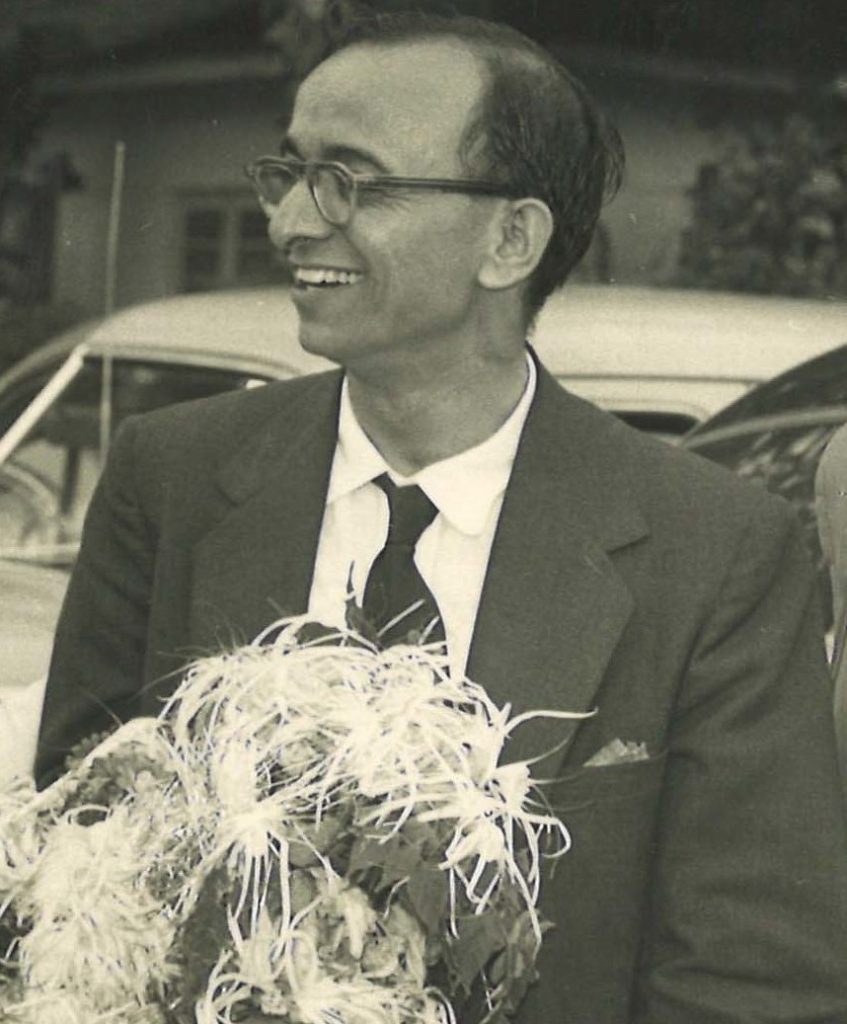

Umashankar Jethalal Joshi (21 July 1911 – 19 December 1988) was an Indian poet, playwright, critic and scholar who wrote in Gujarati. The leading Gujarati poet of his time, he was also a teacher, an editor and a public figure who spoke for the freedom of the writer. He shared the Jnanpith Award in 1967 for his collection Nishith.
Quick Facts
| Full name | Umashankar Jethalal Joshi |
| Pen name | Vasuki (early) |
| Born | 21 July 1911, Bamna, Idar State (now in Aravalli district, Gujarat) |
| Died | 19 December 1988, Bombay (aged 77) |
| Language | Gujarati |
| Occupation | Poet, playwright, short-story writer, critic, academic |
| Notable works | Vishwa Shanti, Gangotri, Nishith, Sapna Bhara, Shravani Melo, Mahaprasthan |
| Awards | Ranjitram Suvarna Chandrak (1939), Jnanpith Award (1967), Sahitya Akademi Award (1973) |
| Positions | Vice-Chancellor, Gujarat University; Member, Rajya Sabha; President, Sahitya Akademi |
| Spouse | Jyotsna Joshi (m. 1937) |
Early Life
He was born at Bamna, a small village in the Aravalli hills of the old Idar state, the third of nine children of a Brahmin family. His father managed the affairs of local landholders. He went to school at Idar and matriculated from Ahmedabad in 1928.
The Freedom Movement
At Gujarat College he answered Mahatma Gandhi‘s call in 1930, left his studies and joined the satyagraha. He was imprisoned twice, in 1930 and in 1932. In jail, at the age of twenty, he wrote Vishwa Shanti (“World Peace”), a long poem inspired by Gandhi that made him known across Gujarat.
He completed his B.A. from Bombay in 1936 and an M.A. in Gujarati in 1938.
Career
Poetry
- Gangotri (1934): poems of social concern, including the famous lines warning that when the hunger of the poor awakes, not a speck of the palaces will remain
- Nishith (“The God of Midnight”, 1939): lyrics and meditations of greater range, for which he received the Jnanpith Award in 1967, shared with the Kannada poet Kuvempu
- Prachina and Mahaprasthan: verse dialogues on episodes from the epics
- Atithya, Vasant Varsha, Abhijna, Dharavastra, Saptapadi
His work moved over the decades from Gandhian idealism to a more inward and modern voice, as in the poem “Chhinnabhinna Chhun” (“I Am in Fragments”).
Other writing
Sapna Bhara (1936) is a collection of one-act plays of village life; Shravani Melo and Visamo are short stories. He wrote criticism, edited old Gujarati texts, and translated Kalidasa’s Shakuntala and Bhavabhuti’s Uttararamacharita.
Sanskriti
In 1947 he founded the monthly Sanskriti, which he edited for thirty-seven years. It was the leading journal of ideas in Gujarati.
Teacher and Vice-Chancellor
He taught in Bombay and Ahmedabad, became professor of Gujarati at Gujarat University in 1954 and director of its school of languages, and served as Vice-Chancellor from 1966 to 1972.
Public Life
- **Rajya Sabha:** nominated member, 1970–1976
- **Sahitya Akademi:** President, 1978–1982
- **Visva-Bharati:** Chancellor, 1979–1982
In Parliament he opposed the Emergency of 1975 and the censorship of the press, one of the few nominated members to do so. He stood throughout for the independence of writers and universities.
Awards
- Ranjitram Suvarna Chandrak, 1939
- Jnanpith Award, 1967
- Sahitya Akademi Award, 1973, for the critical work Kavini Shraddha
Personal Life
He married Jyotsna in 1937. They had two daughters, Nandini and Svati; Svati Joshi became a scholar of English literature. He died of cancer in Bombay in 1988.
Legacy
His centenary was marked across Gujarat in 2011. His line “Vyakti mati banu vishwamanavi”, “let me cease to be an individual and become a citizen of the world”, is often quoted as his creed.
Featured image: Umashankar Joshi in Mumbai in 1960. Photo by Apurva Madia, licensed under CC BY-SA 4.0, via Wikimedia Commons.