


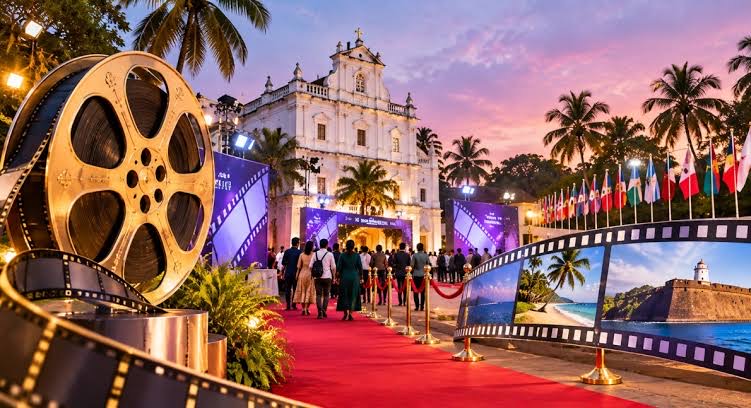
The 57th edition of the International Film Festival of India (IFFI) will be held in Goa from 20 to 28 November 2026, with more than 230 films from India and around the world to be screened under the theme "Stories Without Borders". Chief Minister Pramod Sawant announced the line-up at a press conference on Monday, 16 November. Fatherland, by acclaimed filmmaker Pawel Pawlikowski, is the opening film of the festival. I Matter will feature as a mid-fest film, and We Are All Strangers will close the festival. Spain has been designated the Country of Honour, while Russia will be the Partner Country for the nine-day event. In the Indian Panorama section, Dhurandhar and Becoming are the opening films, as feature and non-feature respectively. The festival is jointly organised by the Union Ministry of Information and Broadcasting and the Goa government, with the Entertainment Society of Goa (ESG) as its nodal agency.
The scale of the programme is considerable. More than 150 of the 230-plus films are international and come from 86 countries, and they will be shown across six venues with 13 screens and a combined seating capacity of over 4,000 delegates. The venues are INOX Panjim, Maquinez Palace, INOX Porvorim, Z Square Samrat-Ashok, Magic Moviez in Ponda and Ravindra Bhavan in Margao, and all of them will have accessibility facilities for persons with disabilities. The Indian Panorama will showcase 25 feature films and 20 non-feature films. The festival will place a special emphasis on BRICS cinema, and it will feature 52 women filmmakers and 62 debut filmmakers. Over 7,000 registrations had been received so far, covering film enthusiasts, film professionals, students and media delegates, the Chief Minister said. The opening and closing ceremonies will be held at the Dr Shyama Prasad Mukherjee Indoor Stadium near Panaji on 20 and 28 November.
The case for IFFI's current shape is that it tries to be several things at once, and succeeds at least in giving each audience something. For cinephiles, the programme brings a wide range of world cinema to Goa. For the film industry, the WAVES Film Bazaar offers filmmakers, producers, buyers and distributors a platform to explore collaborations, co-productions and business opportunities. For young talent, the sixth edition of Creative Minds of Tomorrow (CMOT) will bring together 100 selected participants across 13 filmmaking crafts, and the focus on 62 debut filmmakers and 52 women filmmakers signals an effort to widen who gets seen. Fourteen masterclasses, workshops, panel discussions, retrospectives and interactive sessions are planned at the Kala Academy from 21 to 27 November, featuring personalities from the film industry. Local cinema is not left out: under the Special Goan Section, 12 films have been selected from 35 entries in the feature and non-feature categories, with Ancessao as the section's opening film. The selection jury was chaired by filmmaker Om Raut, with director Jadumoni Dutta and actor Amruta Khanvilkar as members.
The festival is also trying to reach beyond conventional film halls and registered delegates. An IFFI Parade themed "Celebrating the Joy of Cinema" will be held on 25 November from the ESG premises to the Kala Academy in Panaji, with floats, cultural performances and community participation. Open-air screenings will be organised at Miramar, Ravindra Bhavan in Margao and Vagator Helipad. A public space called IFFIMiles will be set up opposite the ESG premises on the Mandovi promenade, open to both delegates and the general public, with activities celebrating cinema, art, culture, crafts and food. For children, ESG and the National Film Development Corporation, in association with Picture Time, will organise special screenings of educational, inspirational and entertaining films at the Kala Academy from 21 to 28 November. Free transport, including auto-rickshaws and electric buses run by the Kadamba Transport Corporation, will be offered to registered delegates from 8.30 am until the end of the last screening each day, with routes linking Miramar with INOX Porvorim, Magic Moviez in Ponda and Ravindra Bhavan in Margao, and another linking INOX Panjim with the Hotel Taj Cidade de Goa Horizon, where the Film Bazaar is held.
There is, however, a fair set of questions that festival-goers and critics often raise about events of this size, and they apply here too. A programme spread over six venues across Panjim, Porvorim, Ponda and Margao puts a premium on logistics, because delegates have to choose between screenings that may be far apart, and the free transport routes, while helpful, link only some of the venues. The seating capacity of 4,000 delegates, set against more than 7,000 registrations so far, means that popular screenings are likely to be competitive, though registrations and seats are not directly comparable since delegates attend different shows at different times. Another question is what a theme such as "Stories Without Borders" means in practice when the guest countries chosen are as varied as Spain and Russia, and the festival has an emphasis on BRICS cinema. Supporters see this as a reflection of India's wish to engage with many film cultures; sceptics will watch whether the selection feels broad and independent or shaped by diplomacy. Neither view can be tested before the films are screened.
The choice of Dhurandhar as the opening feature of the Indian Panorama is a talking point in its own right. A commercially prominent film opening a section that has traditionally been associated with showcasing the best of Indian cinema as selected by a jury shows that the festival wants to connect with a mass audience, not only with festival regulars. Admirers will say that popular cinema deserves a place on the national showcase, especially when it draws large audiences; critics may say that the slot is better used to highlight smaller films that struggle to find screens. The pairing with Becoming as the non-feature opener, and the section's total of 45 films, suggests the programme is aiming for a mix. The fact that Fatherland, a film by a director known to festival audiences, opens the international side, with I Matter in the middle and We Are All Strangers at the close, follows the usual pattern of pairing marquee titles with discoveries.
Why does the festival matter beyond the week? First, for Goa, as the host State, the festival is a major tourism and cultural event and a showcase for local filmmakers, as the Special Goan Section shows. Second, for Indian filmmakers, it provides a rare chance to see their work alongside films from 86 countries and to meet buyers and collaborators through the Film Bazaar. Third, for audiences who do not live near a film club or an art-house cinema, the open-air screenings and the public IFFIMiles area are an invitation to see films in a more informal setting. The involvement of the Union ministry and the State government shows how much policy weight is attached to the event.
The festival begins on 20 November, and the first signals will come quickly: how the opening ceremony and the first screenings run, whether the transport arrangements work, how audiences respond to the Panorama opener and the international competition titles, and how many deals are reported from the Film Bazaar. Delegates and visitors should check the official schedule for screening times and venues, keep a margin for travel between venues, and use the free transport routes where possible. For readers outside Goa, the main thing to follow is the line-up announcements and the award results at the closing ceremony on 28 November.