


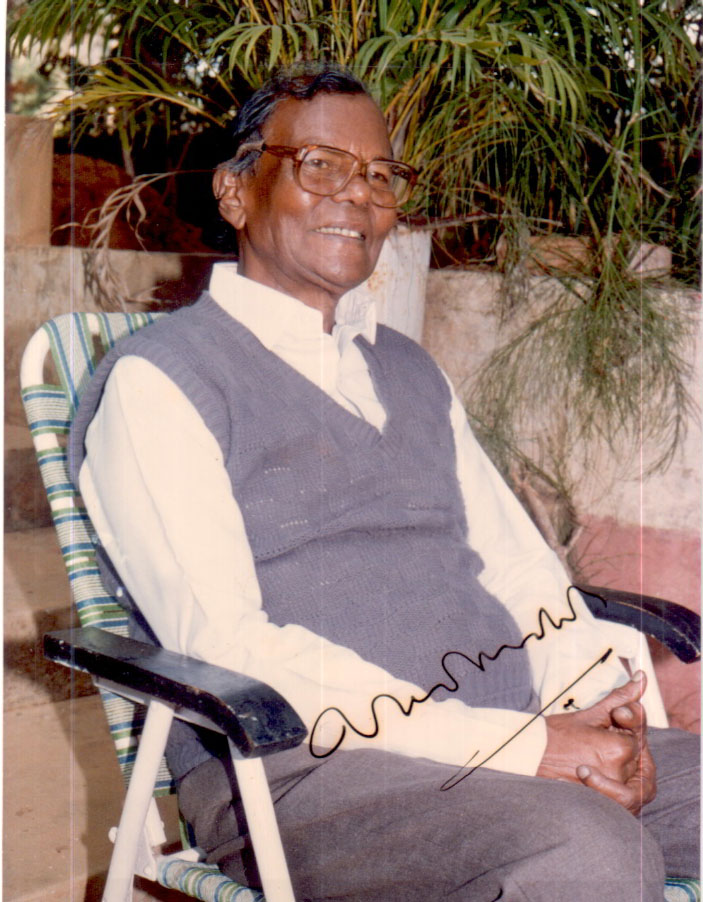

Gopinath Mohanty (20 April 1914 – 20 August 1991) was an Indian novelist who wrote in Odia. A civil servant who spent years among the tribal peoples of southern Odisha, he wrote of their lives with a knowledge and sympathy new to Indian fiction. He received the first Sahitya Akademi Award given for Odia and, in 1973, became the first Odia writer to win the Jnanpith Award.
Quick Facts
| Full name | Gopinath Mohanty |
| Born | 20 April 1914, Nagabali, Cuttack district, Bihar and Orissa Province |
| Died | 20 August 1991, San Jose, California, United States (aged 77) |
| Language | Odia |
| Occupation | Novelist, short-story writer, civil servant |
| Notable works | Paraja, Dadi Budha, Amrutara Santana, Dana Pani, Laya Bilaya, Mati Matala |
| Awards | Sahitya Akademi Award (1955), Jnanpith Award (1973), Padma Bhushan (1981) |
| Spouse | Adaramani Mohanty |
Early Life
He was born at Nagabali, a village on the bank of the Mahanadi in Cuttack district, into a landholding family. His father died when he was twelve, and he was brought up at Patna by his elder brother. Another elder brother, Kanhu Charan Mohanty, became one of the most popular Odia novelists of the century.
He studied at Ravenshaw College in Cuttack and took an M.A. in English from Patna University in 1936. He had hoped to study further in England, but the family could not afford it.
Career
Civil servant
He joined the Odisha Administrative Service in 1938 and served until 1969. Much of his early service was in the hill district of Koraput, among the Paraja, Kondh, Gadaba and Saora peoples. He walked from village to village, learnt their languages, recorded their songs and customs, and took their side against moneylenders and petty officials, which did not always please his superiors. He later compiled grammars and dictionaries of several tribal languages.
Novels
He wrote twenty-four novels and ten collections of short stories.
- Dadi Budha (1944): a Paraja village and the ancient palm tree that is its ancestor-god
- Paraja (1945): a tribal family is drawn into debt by a moneylender and loses land, freedom and finally its restraint. It is his best-known book and has been widely translated.
- Amrutara Santana (“Children of Nectar”, 1947): an epic of the Kondhs. It received the Sahitya Akademi Award in 1955, the first year the award was given.
- Harijan (1948): the scavengers of a Cuttack slum
- Dana Pani (“The Survivor”, 1955): a clerk’s ruthless climb in a company
- Laya Bilaya (“High Tide, Ebb Tide”, 1961): a Calcutta family on holiday at Puri
- Mati Matala (“The Fertile Soil”, 1964): a long novel of village Odisha, written over ten years, for which he received the Jnanpith Award in 1973
Other work
He translated Tolstoy’s War and Peace and Tagore’s Jogajog into Odia, and wrote an autobiography, Srotaswati, in three volumes.
Style
His prose is dense and lyrical, taking in the landscape, the seasons and the speech of his characters, and it brought into Odia the songs and idioms of the hill peoples. Critics have compared his tribal novels with the work of Chinua Achebe.
Awards
- Sahitya Akademi Award, 1955
- Jnanpith Award, 1973, shared with the Kannada poet D. R. Bendre
- Soviet Land Nehru Award, 1970, for his translation of Gorky
- Padma Bhushan, 1981
- Fellow of the Sahitya Akademi
Later Years
After retirement he was for a time a visiting professor at Utkal University. In 1986 he went to the United States as an adjunct professor of social sciences at San Jose State University in California. He died at San Jose in 1991.
Personal Life
He married Adaramani. His children settled in the United States.
Legacy
Paraja, Dadi Budha, Dana Pani and Amrutara Santana are all available in English, and he is regarded as one of the major Indian novelists of the twentieth century.
Featured image: Gopinath Mohanty in his later years. Photo by Omkarmohanty45, licensed under CC BY-SA 4.0, via Wikimedia Commons.