


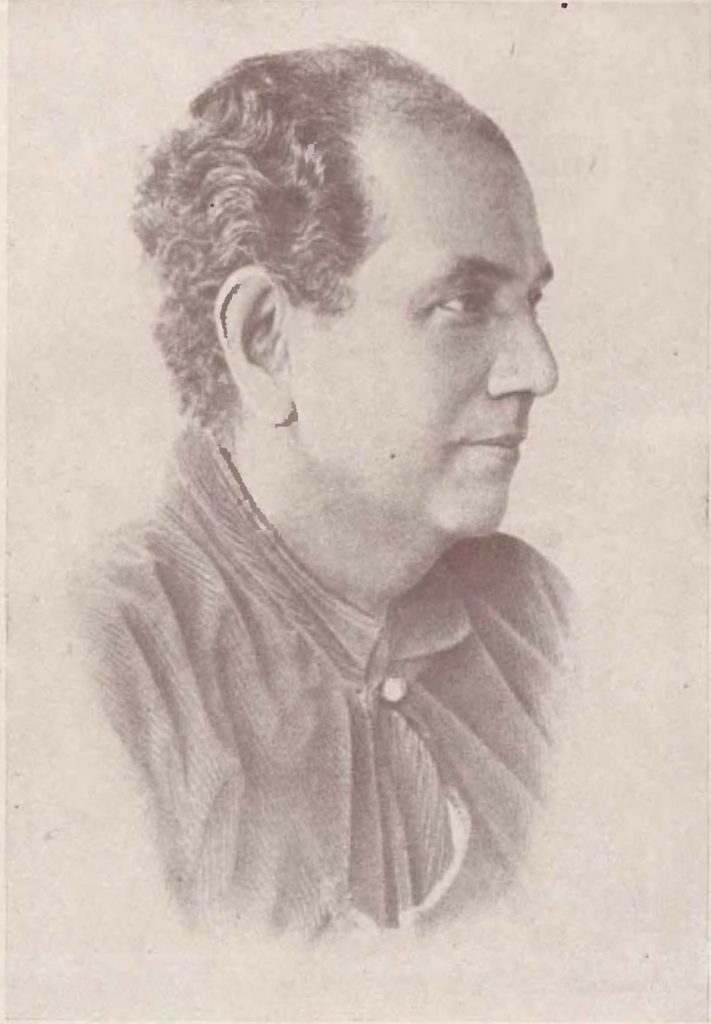

Abanindranath Tagore (7 August 1871 – 5 December 1951) was an Indian painter and writer, the founder of the Bengal School of art and the first major artist of the Indian national movement. Rejecting the European academic manner taught in the colonial art schools, he created a modern Indian style from Mughal and Rajput miniatures, the murals of Ajanta and the wash painting of Japan. His Bharat Mata of 1905 became an icon of the freedom struggle. He was also one of the finest writers for children in Bengali.
Quick Facts
| Full name | Abanindranath Tagore |
| Born | 7 August 1871, Jorasanko, Calcutta |
| Died | 5 December 1951, Calcutta (aged 80) |
| Occupation | Painter, writer, teacher |
| Known for | Founding the Bengal School of art |
| Notable paintings | Bharat Mata; The Passing of Shah Jahan; the Krishna Lila series; the Omar Khayyam and Arabian Nights series |
| Notable books | Kshirer Putul; Rajkahini; Buro Angla; Shakuntala |
| Offices | Vice-Principal, Government School of Art, Calcutta; Chancellor, Visva-Bharati (1942–1945) |
| Family | Nephew of Rabindranath Tagore; brother of Gaganendranath Tagore |
Early Life
He was born in the great house of the Tagores at Jorasanko in Calcutta, a grandson of a brother of Debendranath Tagore, and so a nephew of Rabindranath Tagore, who was ten years older and encouraged him all his life. The house was full of painters, musicians and writers; see Debendranath Tagore.
He studied at the Sanskrit College and learnt to draw and paint from European artists in Calcutta: pastels from an Italian and oils from an Englishman. He became accomplished in the Western manner and found that it did not satisfy him.
The Turn
In the mid-1890s an album of Mughal miniatures and a gift of Irish illuminated manuscripts set him on a new path. He painted a series on the life of Krishna in a manner that combined the old Indian miniature with what he had learnt.
In 1897 he met E. B. Havell, the English principal of the Government School of Art, who had removed the plaster casts of Greek statues from its classrooms and wanted Indian students to study Indian art. Havell made him vice-principal in 1905. The two were bitterly attacked by those who thought that only European methods were serious.
Japan
In 1902 the Japanese thinker Okakura Kakuzo came to Calcutta with a message of Asian unity, and painters he sent stayed with the Tagores. From them Abanindranath learnt the technique of the wash: the paper is painted, dipped in water, and painted again, many times, so that the colours sink into a soft, luminous haze. It became the mark of the Bengal School.
Paintings
- The Passing of Shah Jahan (1902): the dying emperor gazing from his prison at the Taj Mahal, painted after the death of the artist’s own small daughter; it won a medal at the Delhi exhibition of 1903
- Bharat Mata (1905): painted during the agitation against the partition of Bengal. India is shown as a young woman in a saffron robe, with four arms, holding a book, sheaves of rice, a piece of white cloth and a rosary: learning, food, clothing and spiritual strength. Sister Nivedita wanted it carried from one end of the country to the other.
- illustrations to the Rubaiyat of Omar Khayyam
- the Arabian Nights series (1930), in which the tales are set in the Calcutta of his own day, considered his finest work
- portraits, landscapes and, in old age, small sculptures made from twisted roots and scraps of wood
The Bengal School
In 1907, with his brother Gaganendranath, he founded the Indian Society of Oriental Art to exhibit and promote the new work. His pupils carried it across the country as heads of art schools from Lahore to Madras: Nandalal Bose, Asit Kumar Haldar, Kshitindranath Majumdar, Mukul Dey, K. Venkatappa and others. For a generation it was the national style. Later artists reacted against its sweetness and its backward look, but they began from the freedom he had won.
Writer
He wrote in a Bengali that sounds like a storyteller talking to a child, and illustrated his books himself.
- Shakuntala and Kshirer Putul (“The Doll of Condensed Milk”), a fairy tale
- Rajkahini, legends of the Rajput kings
- Buro Angla, the travels of a boy shrunk to the size of a thumb
- memoirs of the Jorasanko house, dictated in his last years
He also lectured on art as the first holder of a chair at Calcutta University, and the lectures are classics of Bengali prose.
Later Years
After Rabindranath’s death he was Chancellor of Visva-Bharati for some years. The old family house was sold, and he moved to a garden house north of Calcutta, where he died on 5 December 1951.
Featured image: Abanindranath Tagore. Photo by an unknown photographer, in the public domain, via Wikimedia Commons.