



The United States raised tariffs on Indian goods to 50 percent on 27 August 2025, the highest rate faced by any major Asian economy at the time. The measure combined a 25 percent reciprocal tariff with a further 25 percent penalty that Washington tied to India’s continued purchases of Russian oil. The additional duty was imposed under Executive Order 14329 of 6 August 2025, titled “Addressing Threats to the United States by the Government of the Russian Federation”. For Indian exporters the effect was immediate, and a slow-moving trade negotiation became the sharpest dispute between the two governments in decades.
The comparison with neighbours made the move politically sensitive in New Delhi. Foreign Policy later noted that Pakistan’s proposed US tariff rate was reduced from 29 percent to 19 percent while India’s rose to 50 percent. Some Indian commentators read the gap as a sign that Washington was using tariffs as political pressure, though no official has said so. The US administration’s stated rationale was different: it described the extra duty as a response to India’s energy purchases from Russia, a country the United States says it wants to isolate over its war in Ukraine.
On 6 February 2026, the two governments announced a framework for an interim trade agreement. According to the joint statement published by the White House, the United States would apply an 18 percent reciprocal tariff on Indian goods, down from 25 percent, and remove reciprocal tariffs on selected items including generic pharmaceuticals, gems and diamonds, and aircraft parts. India would receive a preferential tariff-rate quota on automotive parts. Reports on the deal also said the separate 25 percent penalty linked to Russian oil was removed, although the joint statement itself does not mention Russian oil at all.
India made substantial commitments in return. The joint statement says it will eliminate or reduce tariffs on US industrial goods and a range of food and agricultural products, and address non-tariff barriers affecting US medical devices and information and communications technology goods. India also committed to purchase $500 billion of US energy products, aircraft and aircraft parts, precious metals, technology products and coking coal over five years. The deal also covers Indian farm products, an area Delhi has long guarded closely, so the farm provisions drew attention. The details of what is covered will be settled only in the final agreement.
As of 1 October 2026 the broader Bilateral Trade Agreement remained unsigned, with Commerce Minister Piyush Goyal and US Trade Representative Jamieson Greer still negotiating its terms. The February framework has stayed in effect in the meantime. The episode shows how quickly tariff policy can swing in both directions under the current US administration: Japan and Australia, India’s partners in the Quad, also faced new US tariffs, according to Foreign Policy. Whether the 18 percent rate becomes permanent depends on a final agreement that both sides say they still want, and no signing date has been announced.
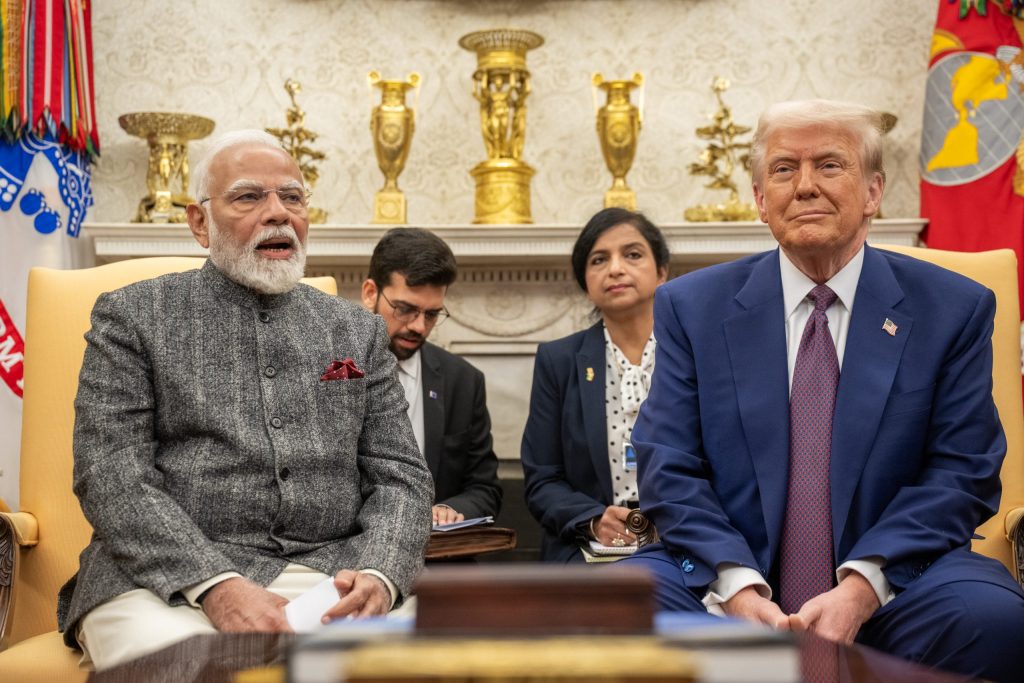
Featured image: Prime Minister Narendra Modi and US President Donald Trump meet at the White House in Washington on 13 February 2025. Photo by The White House, in the public domain, via Wikimedia Commons.