


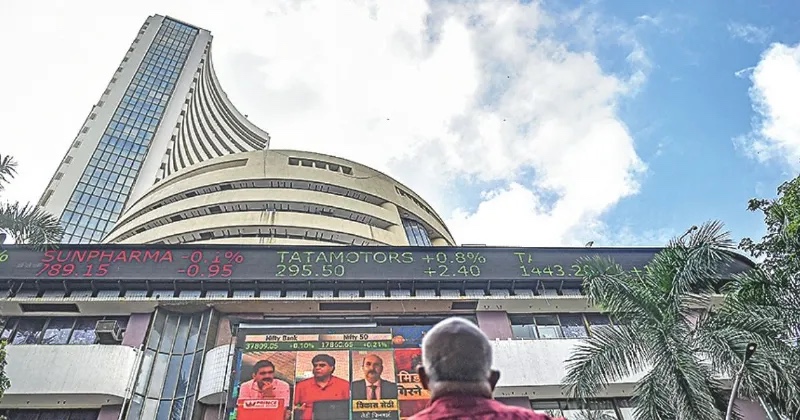
Indian equity benchmarks fell sharply on Monday, 23 November 2026, with the Sensex crashing 1,484 points and the Nifty sliding below the 25,350 mark, as banking stocks and profit-taking after a strong run pulled the markets lower. The 30-share BSE Sensex tanked 1,483.72 points, or 1.77%, to settle at 82,435.99, even though it had begun the session on a positive note. During the day it dropped as much as 1,523.83 points, or 1.81%, to 82,395.88. The 50-share NSE Nifty tumbled 450.95 points, or 1.75%, to end at 25,349.65. The rupee, which had enjoyed a five-session rally, also gave way, losing 30 paise to settle at 92.92 against the US dollar.
The scale of the fall stands out against the preceding days. Both indices had ended the previous two sessions with gains of more than 1%. On Friday, 20 November, the Sensex jumped 897.96 points, or 1.08%, to settle at 83,919.71, and the Nifty rallied 286.30 points, or 1.12%, to end at 25,800.60. For the full week, the BSE benchmark gained 2,327.26 points, or 2.85%, and the Nifty climbed 656.3 points, or 2.61%. Monday's drop therefore wiped out a good part of that gain in a single session.
Banks were the main drag. Among Sensex constituents, Axis Bank fell 3.95%, ICICI Bank 3.39%, HDFC Bank 3.22%, State Bank of India 2.91% and Kotak Mahindra Bank 2.52%. Tata Steel was the worst performer on the index, slumping 8.16% after the company said it had executed an agreement to acquire the entire 26.6% promoter stake in APL Apollo Tubes Limited for ₹15,510 crore and plans to take over another 26% in the pipes and tubes maker through an open offer of ₹16,756 crore, a move that will increase the Tata group firm's downstream production capabilities three times. On the other side, Tata Consultancy Services, Tech Mahindra, HCL Tech, Titan, ITC and Infosys were among the winners.
Market commentators pointed to a mix of domestic profit-booking and global jitters. "Indian equity markets ended sharply lower on Monday, reversing an initial gap-up opening as investors booked profits following four consecutive weeks of gains, recent record highs in Bank Nifty and the Nifty's approach towards the 26,000 mark," said Ponmudi R, CEO of Enrich Money, an online trading and wealth tech firm. "Selling was concentrated in banking, financial services and metal stocks, dragging the benchmark indices lower." In a morning note, he had warned that weak global cues, after a technology-led sell-off in US markets that reignited concerns over AI valuations, global risk appetite and the sustainability of the recent rally, could make for a volatile session. He had also noted that Indian equities had shown relative resilience in recent sessions, helped by improving foreign flows, lower crude prices and a stabilising rupee.
The global backdrop was indeed sharply negative. The US equity markets ended significantly lower on Friday, 20 November, with the Nasdaq Composite tanking 5.28%, the S&P 500 down 3.70% and the Dow Jones Industrial Average declining 1.93%. In Asian markets on Monday, South Korea's Kospi tumbled 3.31%, while Shanghai's SSE Composite index ended largely flat and Hong Kong's Hang Seng ended marginally lower. European markets were trading in positive territory. Brent crude, the global oil benchmark, declined 0.68% to $91.94 a barrel. A day earlier, foreign institutional investors had been buyers: they bought equities worth ₹10,308.42 crore on Friday, 20 November, according to exchange data, a sign that foreign flows were supportive going into the weekend.
The currency tells a related story. The rupee lost 30 paise to settle at 92.92 (provisional) against the US dollar on Monday, reversing its five-day rally, as the sell-off in domestic stock markets overwhelmed supportive factors. At the interbank foreign exchange market, the rupee opened at 92.47 and climbed to 92.43 initially, but then lost ground and hit the day's low at 93.11 before ending the session at 92.92. Lower crude oil prices and a softening American currency failed to support the local unit, which faced intense volatility amid a global stock market rout, forex traders said. Anuj Choudhary, research analyst at Mirae Asset Sharekhan, said the rupee reversed its morning gains on the sharp fall in domestic equity markets, though the softening of the US dollar and a decline in US Treasury yields cushioned the downside, while crude oil prices were also weak.
Looking at the five-day run that preceded the fall puts Monday in perspective. On Friday, the rupee appreciated for the fifth consecutive session to settle 70 paise higher at 92.62 against the dollar, reclaiming the 93 level for the first time since 10 April. Since its closing level of 94.19 on 13 November, the Indian unit had logged a sharp appreciation of more than 1.6% over five back-to-back sessions. Monday's fall of 30 paise, therefore, was a pause rather than a reversal of the full move, but it showed how sensitive the currency remains to equity flows.
Other numbers add to the picture. The dollar index, which gauges the greenback's strength against a basket of six currencies, was at 103.69, lower by 0.05%. Mr. Choudhary said the easing of the dollar index from a 19-month high, on trimming odds of a 50 basis point rate hike by the US Federal Reserve in December, might also support the rupee, but he cautioned that any further correction in domestic markets could cap a sharp upside. He expected the spot USD-INR price to trade in a range of ₹92.70 to ₹93.30 and said traders might take cues from US PMI data. Separately, the Reserve Bank of India's latest data showed the country's foreign exchange reserves dropped $14.205 billion to $705.342 billion in the week ended 13 November, after jumping $2.49 billion to $719.547 billion in the previous reporting week.
There was some positive news from the real economy on the same day. According to Commerce and Industry Ministry data released on Friday, output of key infrastructure industries rose 10.9% in October, the fastest pace in the new series, driven by double-digit growth in coal, iron ore, electricity and cement production. Core industries output had expanded by 0.8% in October last year and 8.2% in September 2026. That strong print, however, was not enough to offset the mood on the trading floor, which was dominated by global risk aversion and profit-taking.
What should investors take from the session? First, the fall was concentrated in sectors that had led the recent rally, namely banks and metals, which suggests it was driven more by positioning than by any change in fundamentals. Second, the decline in the US tech sector on Friday, which was the immediate trigger for the global jitters, shows how closely Indian markets still track global sentiment, even when flows from foreign investors are supportive. Third, the rupee's behaviour confirms that currency and equity markets are moving together at present, with equity weakness quickly translating into a weaker rupee.
The outlook is uncertain. Ponmudi R's remark that the market's ability to withstand deteriorating global risk appetite and defend key support levels will be critical in determining whether the uptrend retains momentum or gives way to profit-booking sums up the choice facing investors. With the Nifty having approached 26,000 earlier, Monday's close at 25,349.65 leaves it more than 650 points below that milestone. The next few sessions, which will bring more global data and further reaction to the US sell-off, will show whether Monday was a one-day shakeout or the beginning of a deeper correction.