


The rupee closed at 94.91 against the US dollar on Monday, 19 October 2026, after trading between 94.75 and 94.97 during the session. That is about 2 percent stronger than its record low of 96.97, reached in May, and the currency has recovered from a low near 97 in early October, when it was just 0.2 percent from the record. On 21 October it strengthened about 0.44 percent to 94.45 on hopes of an India-US trade deal. Behind the recovery, India's foreign exchange reserves fell by $8.578 billion to $726.03 billion in the week ended 9 October, the fifth weekly fall in a row, and foreign investors sold Rs 1,148.64 crore of Indian shares on 19 October alone.
The argument that the rupee is under pressure begins with the reserves and the flows. Reserves have fallen about $59.7 billion, or 7.6 percent, from their peak of $785.71 billion on 4 September. Foreign investors have sold almost $30 billion of Indian equities this year, and the Dollar Index stood at 101.93, up 0.09 percent. Brent crude was at $108.58 on 19 October and above $110 on 21 October, which is costly for a country that imports about 88 percent of its crude. Gaurav Garg of Lemonn said that central bank measures may stabilise short-term moves but that a sustainable recovery depends on lower oil prices and better foreign capital flows. The RBI raised the repo rate to 5.50 percent on 7 October, yet the rupee kept weakening that week.
The argument that the situation is under control is also on the record. Moves of two paise, about 0.02 percent, on 19 October show that the market is not in panic, and the rupee has rallied for six straight sessions to 94.89 on 16 October, more than 2 percent above its 8 October low. Reserves of $726.03 billion are still large, and the weekly fall of $8.578 billion is about 1.2 percent of the total. Reserves also change because of valuation and the central bank's smoothing sales, so the weekly figure is not a measure of dollars sold. Anuj Choudhary of Mirae Asset Sharekhan expects a positive bias from dollar weakness, though elevated crude and foreign selling may limit sharp gains.
A rupee near 95 matters for ordinary households because it raises the cost of imported oil, electronics and fertiliser, and makes foreign education and travel more expensive. It helps exporters, including those who will use the new trade agreements, and it raises the rupee value of remittances. For the Reserve Bank, the choice between spending reserves and letting the currency fall is a continuing balance, and the weekly reserve data will be watched for further falls. Foreign investors holding Indian assets also face a currency loss when the rupee falls, which can add to selling. Students paying fees abroad and families sending money overseas feel the change within weeks.
The rupee is steady for now but exposed to oil and capital flows. A fall below the May low of 96.97 would be a new record and would raise the pressure on prices.
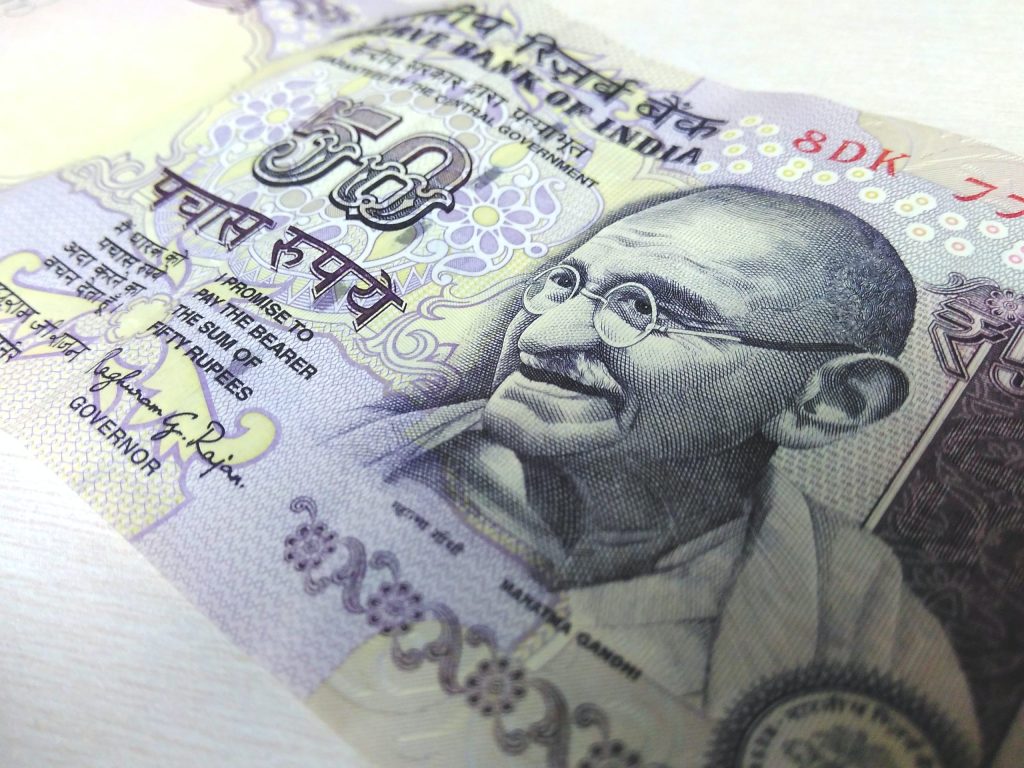
Featured image: An Indian 50-rupee banknote (file photo). Photo: Sohel Patel, CC0, via Wikimedia Commons.