


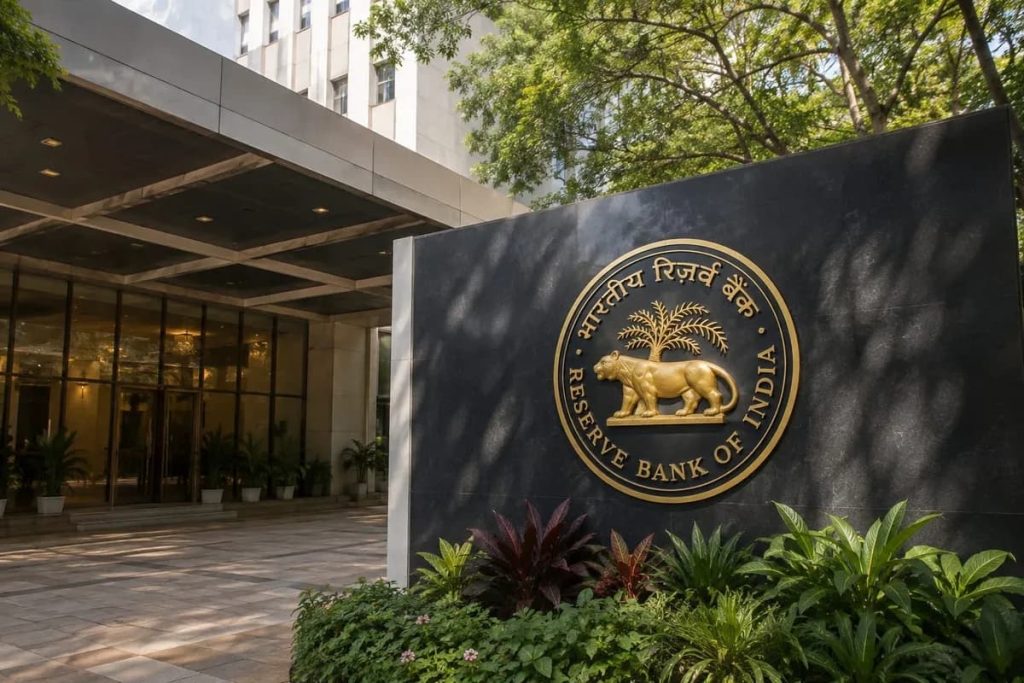
The Reserve Bank of India on Friday, 27 November 2026, eased the minimum daily maintenance requirement for the cash reserve ratio (CRR) from 99% to 90%, a move expected to release more than ₹40,000 crore into the banking system and provide banks with additional funds for lending, The Hindu reported. The change takes effect from the fortnight beginning 1 December 2026. It reverses the tightening the central bank introduced on 9 October,, and it is a signal about how the RBI reads liquidity conditions.
The RBI's statement explained the decision in short, technical language. "On the basis of an assessment of the current and evolving macroeconomic situation and liquidity conditions, it has been decided to reduce the minimum daily maintenance of the cash reserve ratio (CRR) from 99% of the requirement to 90% effective from the fortnight beginning December 1, 2026," the central bank said. Under the revised arrangement, scheduled banks will be required to maintain at least 90% of their prescribed CRR on each day of the reporting fortnight. The average daily CRR maintained during the fortnight, however, must not fall below the level prescribed by the RBI. The prescribed CRR itself is unchanged at 3% of a bank's net demand and time liabilities (NDTL).
It helps to be clear about what has and has not changed. The CRR is the portion of deposits that commercial banks must keep with the central bank in cash, and it earns them no interest, which makes it a blunt but powerful tool for managing liquidity. The headline rate stays at 3% of NDTL; what the RBI has altered is the daily floor within the fortnightly averaging window. Previously a bank had to hold 99% of the required amount every single day, leaving little room to manoeuvre. With the floor at 90%, a bank can run lower on some days and higher on others, as long as the average over the fortnight meets the prescribed level. In practice that frees up cash that was tied up in the daily buffer, which is the source of the estimated ₹40,000 crore-plus release.
The move undoes a decision taken less than two months ago. On 9 October, shortly after the previous Monetary Policy Committee meeting, the RBI had raised the minimum daily CRR maintenance requirement from 90% to 99%, effective from the fortnight beginning 16 October 2026. The Hindu noted that the earlier move came when the banking system was flush with liquidity following substantial mobilisation of funds through foreign currency non-resident (FCNR-B) deposits. In other words, the October step was designed to absorb surplus liquidity, and Friday's step is designed to put some of it back. The fact that the RBI has changed course so quickly says something about how quickly conditions have moved.
Why does it matter for ordinary borrowers and savers? The immediate beneficiaries are banks, which gain more room to lend or to manage short-term cash needs without borrowing from the market or the central bank's facilities. Whether that translates into cheaper or more plentiful credit depends on how banks use the extra funds, and on what else is happening to rates, deposits and demand. The Hindu's report describes the intended effect as providing banks with additional funds for lending. A change in the daily maintenance norm is not a cut in the policy rate, and it does not alter the cost of the RBI's repo window, so any effect on loan pricing is likely to be indirect and gradual.
The timing is also worth noting against the day's market backdrop. The Hindu reported separately on Friday that the rupee fell 60 paise to settle at 92.98 against the U.S. dollar. A central bank that wishes to support the currency usually wants tighter liquidity at the margin, while one that wishes to support credit growth wants looser conditions; the decision on CRR maintenance suggests the RBI judged domestic liquidity to be the more pressing matter, or at least that the two objectives can be managed together. The report does not draw this link, and the RBI's statement refers only to the macroeconomic situation and liquidity conditions, so it would be wrong to read more into the timing than the facts support.
For the banking industry, the arithmetic of the daily floor is significant. A requirement of 99% daily meant banks effectively had to hold the full CRR amount every day, which is stricter than the 90% daily floor that applied before the October change. By restoring the 90% floor the RBI returns to the earlier arrangement rather than introducing something new. That makes it a normalisation rather than an experiment, and analysts will be watching whether the central bank also uses other tools, such as open market operations or foreign exchange swaps, to shape liquidity in the weeks that follow.
There is a wider message for markets. The RBI has shown, within 50 days, that it will use the daily CRR floor as an active instrument, tightening when liquidity is abundant and loosening when it is not. That makes liquidity management more responsive but also harder to predict. Banks and treasury desks will have to watch not only the policy rate decided by the Monetary Policy Committee but also the technical settings the RBI adjusts between meetings. The next scheduled policy review, and the data on system liquidity in December, will show whether the ₹40,000 crore release is enough or whether further steps are needed.
A simple illustration, using round numbers that are not from the RBI, shows how the change works. Suppose a bank has net demand and time liabilities of ₹1,00,000 crore. At the prescribed CRR of 3%, it must hold ₹3,000 crore with the RBI on average over the fortnight. Under the 99% rule it had to hold at least ₹2,970 crore on every single day; under the new 90% rule, the daily minimum is ₹2,700 crore. The bank can therefore let its balance dip by up to ₹270 crore on a given day, as long as it makes up the difference on other days and the fortnightly average still reaches ₹3,000 crore. Multiplied across the banking system, that flexibility is what produces the figure of more than ₹40,000 crore that The Hindu cites as the expected release.
Two points are worth keeping in mind when reading the announcement. First, the RBI's reasoning, as quoted, refers to the macroeconomic situation and liquidity conditions rather than to any specific shock, so observers should be careful about attributing the decision to a single cause. Second, the October step was itself linked to the surge of FCNR-B deposits that had left the system flush with funds, which means the reversal indicates that conditions have since changed; how much of that change reflects outflows, currency pressure or credit demand is not spelt out in the report.
For now, the facts are clear and limited. The prescribed CRR remains at 3%; the daily minimum falls from 99% to 90% from the fortnight beginning 1 December; the average over the fortnight must still meet the prescribed level; and more than ₹40,000 crore is expected to be released into the system. Everything else, from the effect on lending rates to the signal for the next policy meeting, depends on how banks respond and on what the central bank does next.