


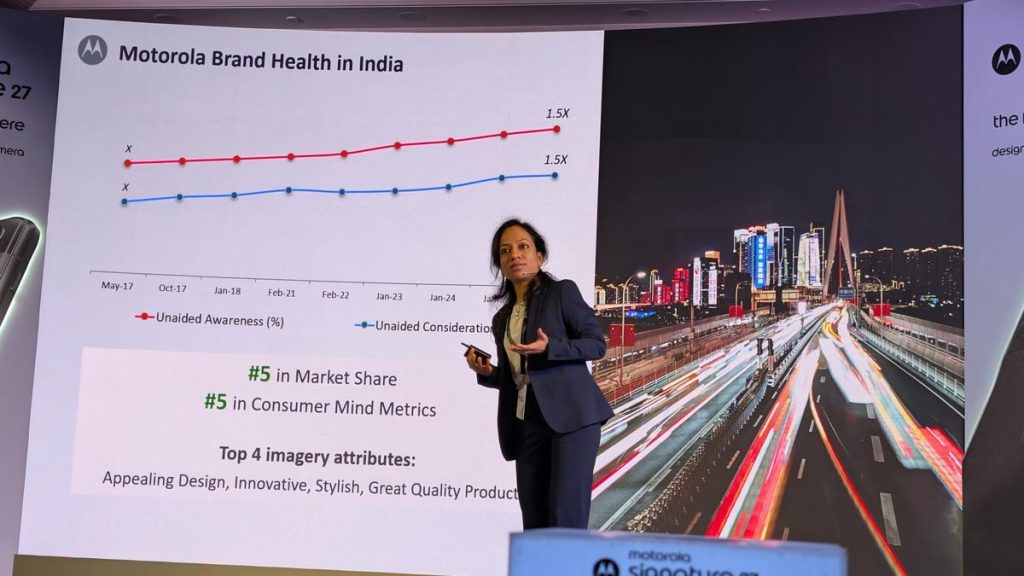
Motorola is aiming for the third spot in India's competitive smartphone market as the Lenovo-owned brand pivots aggressively to premium devices and what it calls seamless connected experiences, The Hindu reported on 27 November 2026. Company executives set out the strategy during a media visit to the Noida facility of contract manufacturer Dixon (Padget Electronics) in Uttar Pradesh. The ambition is bold in a market that has just suffered its sharpest contraction in years, and it rests on a simple bet: that Indian buyers will pay more for better phones even when overall demand is weak.
The starting point is the market structure. India's smartphone market is currently dominated by Samsung, followed by two Chinese players, Vivo and Oppo, according to The Hindu. If Motorola continues its push and its mix of products, the paper says, it could replace Oppo as the third-largest brand in the country. That is a larger claim than it first appears. According to the latest IDC report, Motorola has already climbed to become the fifth-largest smartphone brand in India, with an 8.8% market share in the third quarter of this year. IDC's ranking, as reported by IndiaX24 earlier this month, put Apple fourth with a 10.1% share, ahead of Motorola, with Xiaomi sixth at 8.3%. In other words, Motorola would have to overtake not only Oppo but also Apple, and it would have to stay ahead of Xiaomi, which is only half a percentage point behind it.
The numbers the company itself presents are striking. Motorola says its revenue has surged 20-fold since FY19-20, with nearly 60% now driven by premium devices. The premium portfolio includes the Edge, Razr and Signature series. The upcoming flagship, the Motorola Signature 27, will be made at the Noida facility. Alongside Dixon, the brand has a manufacturing partnership with Neolync in Tirupati, Andhra Pradesh, and together the two sites meet domestic demand and also handle exports to Latin American and North American markets. These are company figures, presented at a company event, and they should be read as claims by the brand; The Hindu does not independently verify the 20-fold increase or the 60% share.
Local manufacturing is a central part of the story. The Hindu reports that Motorola's expansion has generated direct employment for nearly 8,000 people and more than 56,000 indirect opportunities across manufacturing, sales and servicing. For a brand trying to move up the price ladder, a local production base helps in several ways: it supports the government's push for domestic electronics manufacturing, it can shorten supply chains, and it allows India to serve as an export hub, as the Latin and North American shipments suggest. It also gives Motorola a stronger argument in conversations with retailers and policymakers who judge brands by their commitment to the country.
Service is the other pillar. The brand says it covers 716 PIN codes across 620 cities, supported by more than 846 touch points and 685 dedicated repair centres. After-sales support is one of the main reasons buyers hesitate to spend more on a smartphone, so the network matters most precisely where Motorola wants to grow. A premium buyer expects repairs to be quick, and a premium positioning that is not backed by service quickly loses credibility.
On technology, Motorola is doubling down on artificial intelligence, with an emphasis on practical, day-to-day uses. The company has partnered with Google to integrate Gemini Intelligence into the upcoming Signature 27, and it continues to develop its own AI assistant, Qira, which is designed to improve cross-device connectivity and deliver advanced productivity tools. The aim, as the executives describe it, is a connected experience in which a phone, a laptop and other devices work together, which draws on Motorola's ownership by Lenovo. Whether buyers will pay extra for such features is the question every manufacturer is trying to answer.
The case for Motorola's optimism is built on the shape of the market. IDC's third-quarter data, covered in an earlier IndiaX24 report, showed the overall market falling 23.3% year-on-year to 36.8 million units, the steepest quarterly contraction since the fourth quarter of 2022, with rising memory chip costs pushing up prices. Within that decline, the premium end held up much better than the budget end: the $400 to $600 band surged 79.8%, while the $100 to $200 band fell 21.3%. Vivo's shipments fell by nearly 30% and Oppo's by around 27%. A brand whose growth is "heavily anchored" in premium devices, as The Hindu puts it, is positioned on the right side of that shift, and it explains how Motorola could rise to fifth place in a quarter when most brands shrank.
The case for caution is just as strong. First, a rise driven by the weakness of rivals is not the same as a durable lead, and Vivo and Oppo have large offline networks and the scale to respond with their own premium launches. Second, the same memory cost pressure that is reshaping the market affects Motorola's supply and pricing too; IDC expects the pressure to continue in the fourth quarter. Third, premium positioning in India is hard to win against Apple and Samsung, which have deep brand equity at the top end. And finally, Motorola's data comes from its own presentations, so investors and consumers will wait for several quarters of independent IDC numbers before concluding that the third spot is within reach.
What should readers watch? The launch and pricing of the Signature 27 will be the first real test of the strategy, since it combines Noida manufacturing, Gemini integration and a flagship price. The next IDC release will show whether Motorola's 8.8% share holds as the market adjusts to higher costs. The performance of the Edge and Razr lines will indicate whether the premium share is broad or dependent on a few models. And the expansion of service touch points beyond the 716 PIN codes now covered will show whether the brand is serious about the smaller cities where much of India's smartphone demand lies.
For consumers, the broader message is that the mid-premium segment is getting more crowded and more competitive, which usually helps buyers through better specifications and offers, although higher component costs may offset the benefit. For the industry, Motorola's pivot is another sign that India's smartphone market is moving from a volume race to a value race. Whether the company reaches third place or not, the direction of travel is clear: in a shrinking market, the brands that win will be those that persuade people to spend more, not less, and that can make and service their products in India.