


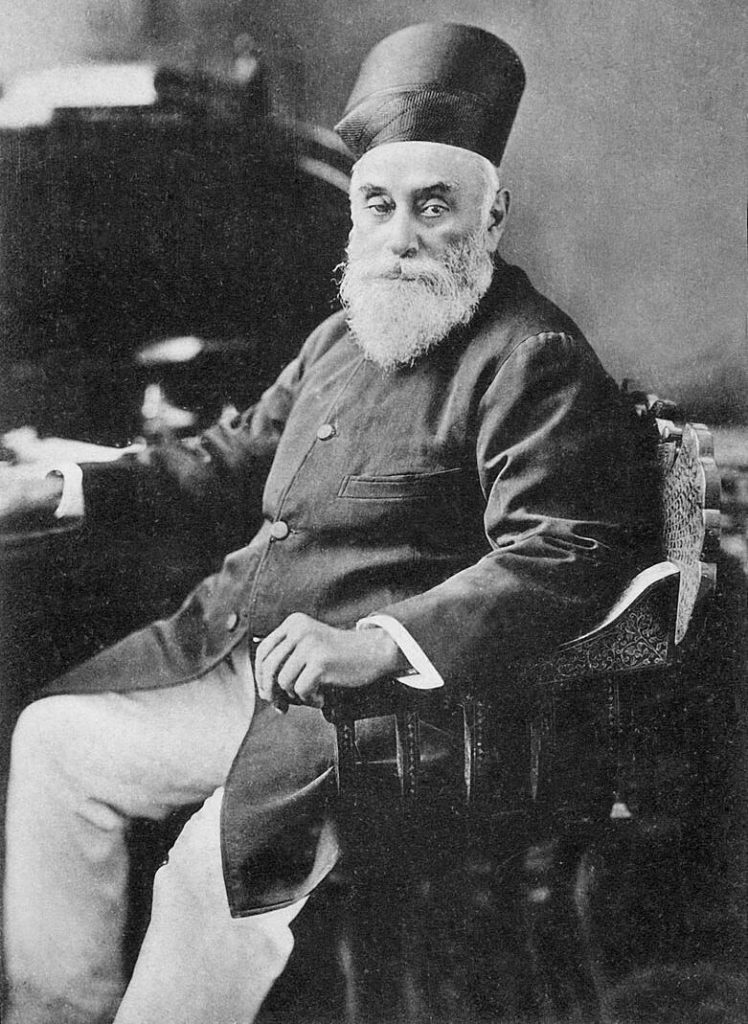

Jamsetji Nusserwanji Tata (3 March 1839 – 19 May 1904) was an Indian industrialist and philanthropist, the founder of the Tata Group. He made his fortune in cotton mills and then set himself four ambitions for his country: an iron and steel works, hydro-electric power, a university of science and a great hotel. He lived to see only the hotel, but his sons completed the rest. He is called the father of Indian industry.
Quick Facts
| Full name | Jamsetji Nusserwanji Tata |
| Born | 3 March 1839, Navsari, Baroda State (now in Gujarat) |
| Died | 19 May 1904, Bad Nauheim, Germany (aged 65) |
| Occupation | Industrialist, philanthropist |
| Founded | Tata Group (1868) |
| Known for | Empress Mills, the Taj Mahal Hotel, the plans for Tata Steel, Tata Power and the Indian Institute of Science |
| Spouse | Hirabai Daboo |
| Children | Dorabji Tata, Ratanji Tata |
Early Life
He was born at Navsari into a family of Parsi Zoroastrian priests. His father, Nusserwanji, was the first of the family to go into business, moving to Bombay to trade. Jamsetji joined him there at fourteen and studied at Elphinstone College, finishing in 1858.
He worked in his father’s firm, which traded with China and, during the American Civil War, in cotton. He was sent to Hong Kong to open a branch and later to England, where he studied the Lancashire textile industry.
Career
Cotton
In 1868, with a capital of 21,000 rupees, he started his own trading company, the beginning of the Tata Group. He bought a bankrupt oil mill in Bombay, turned it into a cotton mill and sold it at a profit.
For his next venture he chose Nagpur, in the middle of the cotton country, far from the established mills of Bombay; people thought the choice eccentric. The Empress Mills opened on 1 January 1877. He installed the newest machinery and introduced benefits for workers that were almost unknown in the world at the time: a provident fund, accident compensation, ventilated workrooms, a crèche and training for apprentices. The mill was highly profitable.
He later started the Svadeshi Mills to spin finer yarn of the kind imported from Britain, a name that anticipated the swadeshi movement.
Four ambitions
- **Steel:** inspired by a lecture of Thomas Carlyle and by a report on iron ore in central India, he spent years and large sums on surveys and visited the steel towns of America. The Tata Iron and Steel Company was founded by his son Dorabji in 1907, and its works rose at the place now called Jamshedpur.
- **Hydro-electric power:** to give Bombay clean power from the rainfall of the Western Ghats. The company was formed in 1910.
- **Science:** in 1898 he offered property worth some thirty lakh rupees, half his wealth, to found a research university. After long delays by the government, the Indian Institute of Science opened in Bangalore in 1909. He had discussed the idea with Swami Vivekananda when they sailed on the same ship in 1893.
- **A hotel:** the Taj Mahal Hotel in Bombay opened on 16 December 1903, the first building in the city lit by electricity, with American fans, German lifts and English butlers. The story that he built it after being turned away from a hotel reserved for Europeans is widely told, though not proved.
Other interests
He introduced the cultivation of silk on Japanese lines in Mysore, experimented with growing Egyptian cotton, and bought land in Bombay and developed it.
Philanthropy
In 1892 he set up the J. N. Tata Endowment to send Indian students of any community abroad for higher studies; many of the early Indian members of the civil service were its scholars. His will left most of his estate to public purposes.
Death and Legacy
He died at Bad Nauheim in Germany in 1904 and is buried in the Parsi cemetery at Brookwood in England. His sons Dorabji and Ratanji carried out his plans and placed their own wealth in charitable trusts, which still own the majority of the group. It was later led by J. R. D. Tata and Ratan Tata. A 2021 study of giving named Jamsetji Tata the world’s greatest philanthropist of the past century, by the present value of his family’s donations.
Featured image: Jamsetji Tata, from a postcard published about 1910. Photo by an unknown publisher, licensed under CC BY 4.0, via Wikimedia Commons.