



India’s crude oil import bill rose sharply this year even though it bought almost the same amount of oil. According to figures from the Petroleum Planning and Analysis Cell, as cited in an analysis, crude imports were 100.7 million tonnes between April and August 2026, down 0.4% from a year earlier, but the import bill rose 48.4% from $50.4 billion to $74.8 billion.
The shock is therefore one of price, not of supply. The analysis described it as one in which the shock went to the price and not the pipeline. That matches the broader economic data: wholesale fuel and power inflation was 25.85% in September, and crude petroleum and natural gas prices were up 57.32% from a year earlier.
The cause is the disruption around the Strait of Hormuz. Reports say that shipping through the strait was severely disrupted from late February 2026 after the US-Israeli air war against Iran, and that before restricted passage began in early March about 45% of India’s crude imports, half of its LNG imports and 90% of its LPG imports passed through it. As of the week of 8 October, crude flows through the strait stood at about 10.1 million barrels a day, or 74% of pre-war levels, and attacks on shipping were at their highest weekly level since the conflict began.
India’s response has been to reroute its purchases. One report said that India has temporarily moved roughly 70% of its crude imports away from the strait, up from 55%, largely by buying Russian crude under temporary US waivers. Another noted that Russia’s share fell from a July high to around 35% in September, so the mix keeps changing. The figures come from secondary analyses, so readers should treat the percentages as approximate.
Prices remain high. Brent crude was around $105 to $107 a barrel in mid-October, with a market report on 14 October saying it was approaching $107. The International Monetary Fund, in its October outlook, assumes oil at $95.74 a barrel for 2026 and $87.39 for 2027, and that the strait reopens in March 2027. If the disruption lasts longer, the bill would stay elevated.
Household effects are visible. The analysis lists retail LPG prices in Delhi on 1 October 2026 as Rs 942 for a 14.2-kilogram domestic cylinder and Rs 2,810 for a 19-kilogram commercial cylinder, although it did not give a source for those prices, and they should be checked against oil company notices. LPG matters because India relies heavily on imports through the Gulf for it.
The broader macro effects run through inflation, the rupee and growth. Higher oil prices raise transport and input costs, which feed retail inflation of 5.54% and wholesale inflation of 11.39%. A larger import bill also increases demand for dollars, which has contributed to the rupee trading around 95 per dollar, and led the Reserve Bank of India to tighten rules on currency derivatives. The central bank’s rate increase on 7 October also cited volatility in global crude prices.
The government and companies have also looked at reducing dependence on imported fuel. One report said the crisis has accelerated interest in coal gasification, in which domestic coal is turned into gas. Such projects take years, so they do not change the present situation.
The numbers show how an energy shock can be costly without any physical shortage. India has maintained its volumes by changing suppliers and routes, but the price paid for the same quantity of crude is far higher, and that cost is spread across the economy.
What happens next depends on the strait and the wider region. Attacks on shipping have increased, and another report noted that Houthi forces captured the port of Mocha on 10 September and advanced towards the Bab-el-Mandeb Strait, which would add another route at risk.
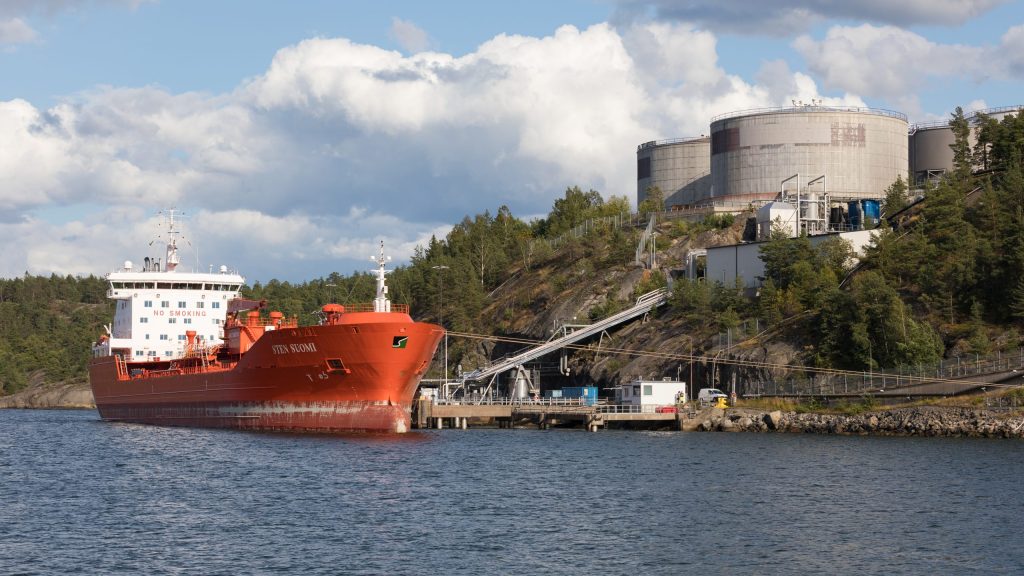
Featured image: An oil tanker at a fuel depot in Stockholm (file photo; a stand-in image, not a photo of Indian imports or the Strait of Hormuz). Photo by Frank Schulenburg, licensed under CC BY-SA 4.0, via Wikimedia Commons.