


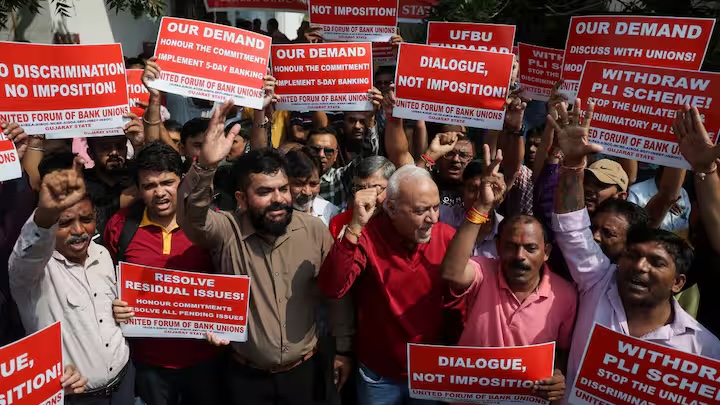
Three of the country's best-known bank unions have called a solidarity strike for 3 December 2026 in support of employees and officers of IDBI Bank who are opposing the government's plan to sell a controlling stake in the lender to Fairfax Financial Holdings. The All India Bank Employees' Association (AIBEA), the All India Bank Officers' Association (AIBOA) and the Bank Employees Federation of India (BEFI) announced the call in a joint statement issued in Hyderabad on Thursday, 19 November 2026. The strike follows a two-day strike earlier in November by IDBI Bank's own staff, and it widens the dispute from one bank to the wider banking sector.
The immediate cause is the government's move to go ahead with the sale. The Government of India and the Life Insurance Corporation of India (LIC) together hold about 94 per cent of IDBI Bank, according to the union leaders, and the proposal is to sell 60 per cent to Fairfax. Other reports on the deal put the stake at 60.72 per cent and the price at about ₹52,878 crore, following approval by the Cabinet Committee on Economic Affairs in October 2026. The United Forum of IDBI Officers and Employees had called the strike on 3 December after the earlier two-day action, and the three national unions have now said that they will join it in solidarity.
The unions' statement was signed by AIBEA general secretary C.H. Venkatachalam, AIBOA general secretary Sanjay Khan and BEFI general secretary Debasish Basu Chaudhury. They argued that IDBI Bank is a profit-making institution with total deposits of about ₹3.50 lakh crore and advances of about ₹2.50 lakh crore, which together translate into a total business of around ₹6 lakh crore. In their view, such a bank should not be sold to a foreign investor. "If it is sold to Fairfax, this swadeshi bank will become a videshi bank. The decision to sell the bank to a foreign investor is totally unwarranted," the leaders said.
The unions' wider case is a defence of public-sector banking. "It is the experience in our country that public sector banks are the safety for the people's savings," they said, noting that many private banks have been closed down because of mismanagement and that people lost their hard-earned savings. According to the statement, all those failed private banks were then taken over by public sector banks. Banks, the union leaders said, hold the precious savings of the people, and total bank deposits in the country are more than ₹250 lakh crore. They described this as the social capital with which further economic development should be ensured, and said that privatisation amounts to handing the savings of the people to private hands.
These arguments are familiar from earlier rounds of bank privatisation debates, but they carry added weight in this case for a particular reason. IDBI Bank was not originally an ordinary commercial bank. It began life as a development finance institution and was later converted into a bank, and the state and LIC took a controlling position in it in earlier years. Because the bank is largely owned by the government and by a government-owned insurer, its sale involves both a strategic disinvestment and a transfer from public hands, which makes it a test case for the government's willingness to reduce its role in the banking sector.
The government's side of the argument rests on different priorities. The usual argument for such a sale is that it brings in a strategic investor with capital, expertise and management capability, and reduces the burden on the exchequer. Reports of the deal have also said that the government has given assurances that the service conditions and pension benefits of existing employees will be protected after the sale. The unions are not convinced. In a representation to the Reserve Bank of India Governor, they raised concerns about the valuation of the bank, the source of the funds used to acquire it, the protection of depositors and the credentials of the proposed buyer. Those objections show that the dispute is not only about jobs but also about how the sale is structured and approved.
The regulatory dimension is important. Under India's banking rules, a substantial acquisition of a bank requires clearance from the Reserve Bank of India, which examines whether a buyer is "fit and proper" and whether the transaction is in the interest of depositors. The unions' decision to address the RBI Governor directly suggests that they hope to influence that stage of the process, even though the Cabinet Committee has already cleared the sale. Whether the RBI shares their concerns is unknown, and the central bank has not been reported to have commented on the representation.
The December 3 strike is likely to affect banking services to some extent, although the scale will depend on how many employees take part. During the two-day strike earlier this month, reports said that more than 10,000 IDBI Bank employees took part, and branch operations faced temporary disruptions, while digital banking channels remained active. Customers who need to deposit cheques, withdraw cash or use branch services on 3 December may find it difficult to do so, especially at IDBI Bank branches, and are advised to complete urgent transactions in advance and to rely on digital channels where possible. Online and mobile banking and ATMs have usually continued to work during bank strikes, although cash availability and cheque clearing can be affected.
The involvement of the national unions changes the character of the protest. AIBEA, AIBOA and BEFI represent employees and officers across the public-sector and some private banks, so a solidarity strike is a way of showing that the concern extends beyond IDBI Bank. The unions are making the case that if one profit-making bank can be sold, others may follow. The government has previously carried out mergers of public-sector banks and has talked of privatising a small number of lenders, and the unions have opposed each step, arguing that public ownership is the basis of financial inclusion and of public trust in the banking system.
For investors and analysts, the strike is a reminder that the sale is not a formality. The Fairfax transaction is one of the largest privatisations in the financial sector in recent years, and the government will want to complete it without prolonged disruption. Labour action can delay a transaction by complicating approvals, though it rarely stops a sale that the Cabinet has cleared. The more significant risk for the government may be political: the language of "swadeshi" and "videshi" is designed to appeal beyond the banking community, and it may be taken up by opposition parties or other groups that are sceptical of foreign ownership in the financial sector.
What happens next will depend on talks and on regulatory steps. The government could open a dialogue with the unions to address concerns about jobs and pensions, or it could proceed with the transaction and treat the strike as a protest to be managed. The RBI's clearance of the buyer will be a key milestone. For the staff of IDBI Bank, the main question is what their working conditions will look like once the new owner takes charge. For depositors, whose money is protected by the usual regulatory safeguards, the practical effect of the dispute will be limited to the days on which strikes interrupt branch services. On 3 December, the question of who should own a bank that holds ₹3.50 lakh crore of deposits will be argued on the streets as well as in the boardroom.