


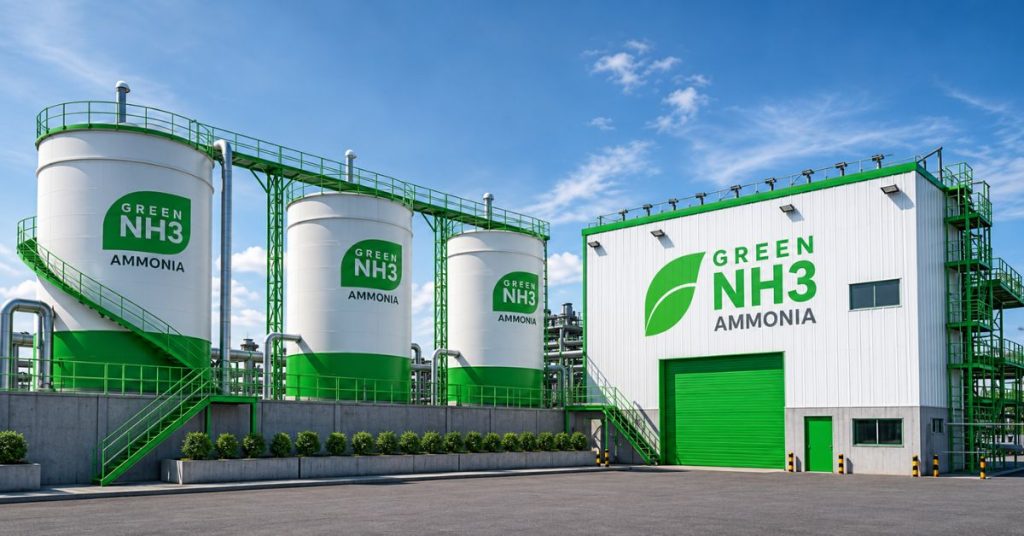
ACME Group has completed the formalities for its $3.6-billion green ammonia project at Paradip in Odisha, a step that it describes as a major move towards large-scale domestic production of what the industry calls green molecules. The company announced on 18 November 2026 that it had taken the final investment decision, and that Brookfield will invest $600 million in the project. With an annual production capacity of 760,000 tonnes, the facility is expected to be commissioned by 2029, which makes it one of the larger green ammonia undertakings announced in the country so far.
The plant is designed to run entirely on renewable energy. It will produce green hydrogen through electrolysers and then convert that hydrogen into ammonia through the Haber-Bosch process, the long-established industrial method that combines hydrogen with nitrogen. The facility will house a 2,200-tonne-per-day ammonia loop, and Thyssenkrupp Uhde has been named as the technology partner. ACME says that the project will comply with the European Union's Renewable Fuels of Non-Biological Origin, or RFNBO, requirements, and that CertifHy, an accredited RFNBO certification body, has examined the renewable electricity arrangements for compliance with the rules on geographical correlation.
The reference to European rules is a commercial signal as much as a technical detail. Green hydrogen and its derivatives only attract premium prices if buyers can show that they were produced from genuinely renewable power, and the EU's framework sets out strict conditions on where and when the electricity must be generated. By designing the project around those conditions, ACME is preparing its output to be acceptable in demanding export markets, even though a large part of the first volumes has been committed to buyers at home and in Japan.
The offtake arrangements are where the project's economics are anchored. Under long-term agreements, 370,000 tonnes of the annual output will be supplied to Indian fertiliser companies through the Solar Energy Corporation of India, or SECI, under the government's Strategic Interventions for Green Hydrogen Transition, known as the SIGHT scheme. A further 83,000 tonnes will go to Japan's IHI under its Long-Term Decarbonisation of Power Auction. Together, those two contracts account for 453,000 tonnes a year, or a little under 60 per cent of the plant's stated capacity. The remaining volume, on the figures given, has not been described in the announcement.
The domestic contracts connect the project to a government effort that has been unfolding for some time. SECI has run auctions under the SIGHT scheme to buy green ammonia for fertiliser plants, in which producers bid for the right to supply the fuel over long periods. The first such auction, held in 2025, discovered a record-low price of ₹55.75 per kilogram for supply to Paradeep Phosphates in Odisha, compared with ₹100.28 per kilogram in 2024, according to a release from the Ministry of New and Renewable Energy. The broader tender covered 724,000 tonnes a year of green ammonia across 13 fertiliser plants. India depends partly on imports for ammonia and fertiliser inputs, so replacing part of that with domestically produced green ammonia is attractive for both energy security and for the farm economy.
ACME's Chairman, Manoj Kumar Upadhyay, said that the final investment decision "marks a critical milestone as we move from ambition to execution at scale". He said the project, which builds on the group's experience in Oman, demonstrates India's ability to produce competitive green molecules for diverse markets. The reference to Oman is meaningful: it signals that ACME is drawing on lessons from a project outside India, rather than starting from scratch, which may reassure financiers who have seen several large hydrogen announcements around the world struggle to reach the construction stage.
Brookfield's role is central to that financing story. The investor has committed $600 million towards ACME's green molecule business, and Murzash Manekshana, its Head of Asset Management in India, Energy, said the investment, alongside ACME's own capital, would support a pipeline of more than 1.5 million tonnes per annum of green molecule projects backed by long-term global offtake commitments. The numbers imply that the Paradip plant, at 760,000 tonnes, accounts for roughly half of the pipeline that the two partners have in view. The announcement does not give a full breakdown of how the $3.6 billion will be funded, so it is not clear what share will come from equity, from debt, or from other sources.
Why Odisha, and why Paradip? The location is a port town on the Bay of Bengal, and the state already has an established fertiliser and industrial base, including the Paradeep Phosphates unit that was the buyer in the first SECI green ammonia auction. Proximity to a deep-water port helps with exports to Japan and other markets, while proximity to fertiliser plants shortens the domestic supply chain. The state has also been courting investment in renewable energy and green hydrogen, and a project of this scale is likely to be presented as a flagship for that effort.
The timeline of 2029 for commissioning deserves attention. Green ammonia plants of this size require large amounts of dedicated renewable electricity, electrolysers built in volume, and careful integration with an ammonia synthesis loop. Each of those elements can be delayed by supply-chain problems, grid-connection issues or cost increases. The company's choice of a recognised technology partner for the ammonia loop is one way of reducing the risk, but investors and customers will still watch for early signs of construction progress, such as electrolyser orders, power-purchase arrangements and port facilities for shipping.
There are also questions that the announcement leaves open. The price at which green ammonia from the plant will be sold is not given in the material reported, and neither is the cost of the electricity that will feed the electrolysers. Both will determine whether the plant can compete with conventional ammonia made from natural gas. The announcement does not say how many jobs the project will create, and it does not describe how it will handle water supply for electrolysis. Those details will probably emerge as the project goes through environmental and local approvals.
Still, the significance of the deal is clear. A $3.6-billion final investment decision is a different order of commitment from a memorandum of understanding, because it means that the sponsors and their financiers are prepared to put money to work. If the plant is delivered on schedule, it would give India a visible example of green molecule production at industrial scale, tie fertiliser makers to long-term supply of non-fossil ammonia, and give Japanese power producers a source of low-carbon fuel. It would also test the claim, repeated by government and industry for several years, that India can become a competitive global producer of green hydrogen derivatives.
For Odisha, the project adds to a growing list of large industrial investments, and for the green hydrogen sector as a whole it provides a data point at a time when many developers are waiting for proof that the business model works. The next milestones will be financial close in full, the start of construction and the signing of any further offtake contracts for the uncommitted capacity. ACME and Brookfield have said they are working on a pipeline of more than 1.5 million tonnes a year, so the Paradip project may be the first of several. For now, the announcement of 18 November 2026 marks the moment at which one of India's biggest green ammonia plans moved from design to execution.